Construction Back-Office Redesign From First Principles
Structural process failures, not staffing gaps, cripple construction back-offices.
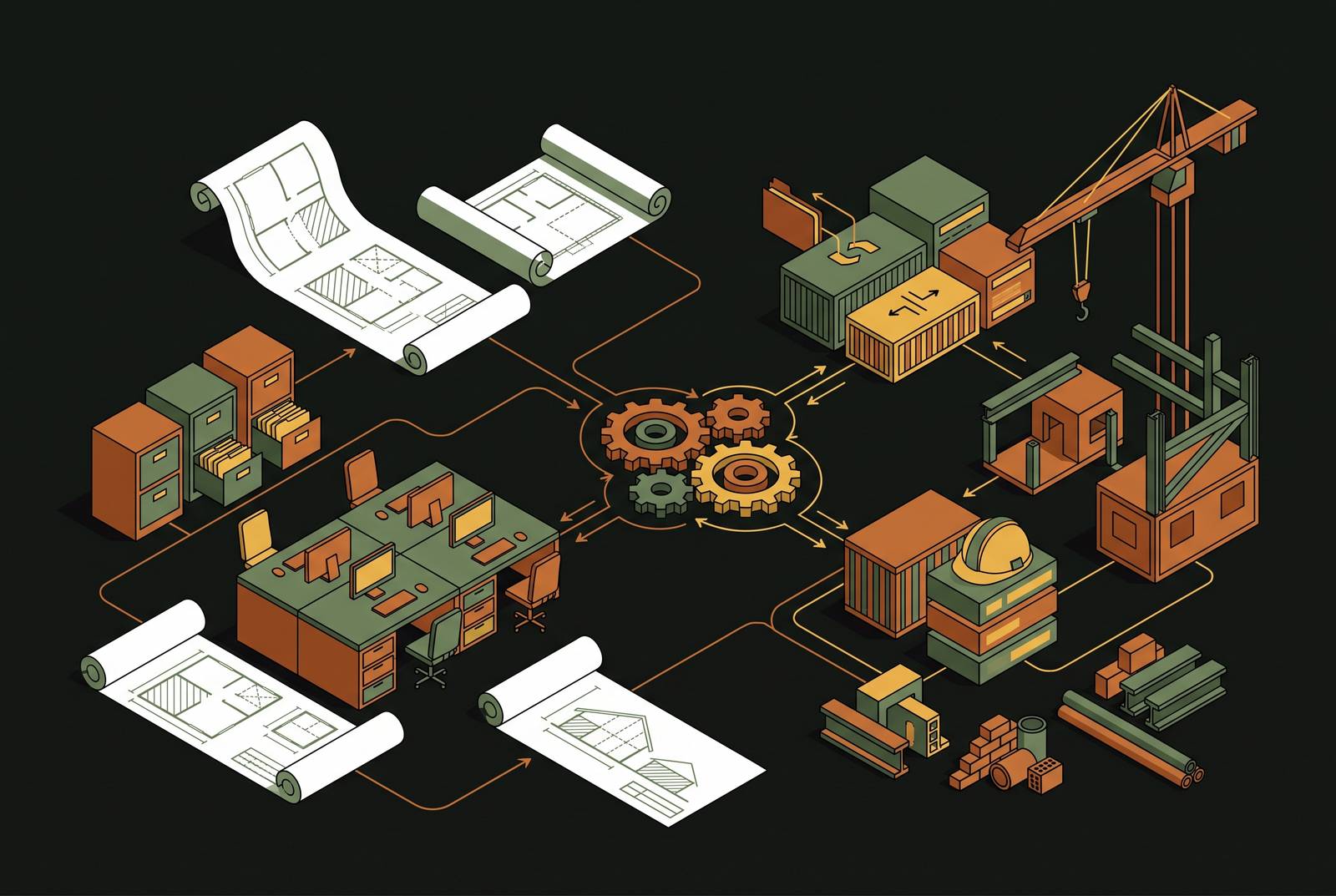
Most construction back-offices are slow because the underlying processes were never designed for the volume, document complexity, or coordination load they now carry. The people running them are not the problem. Redesigning from first principles means mapping how work actually flows before deciding what to rebuild, rather than layering automation onto a sequence that was already failing.
Why construction back-offices are structurally misbuilt, not just understaffed
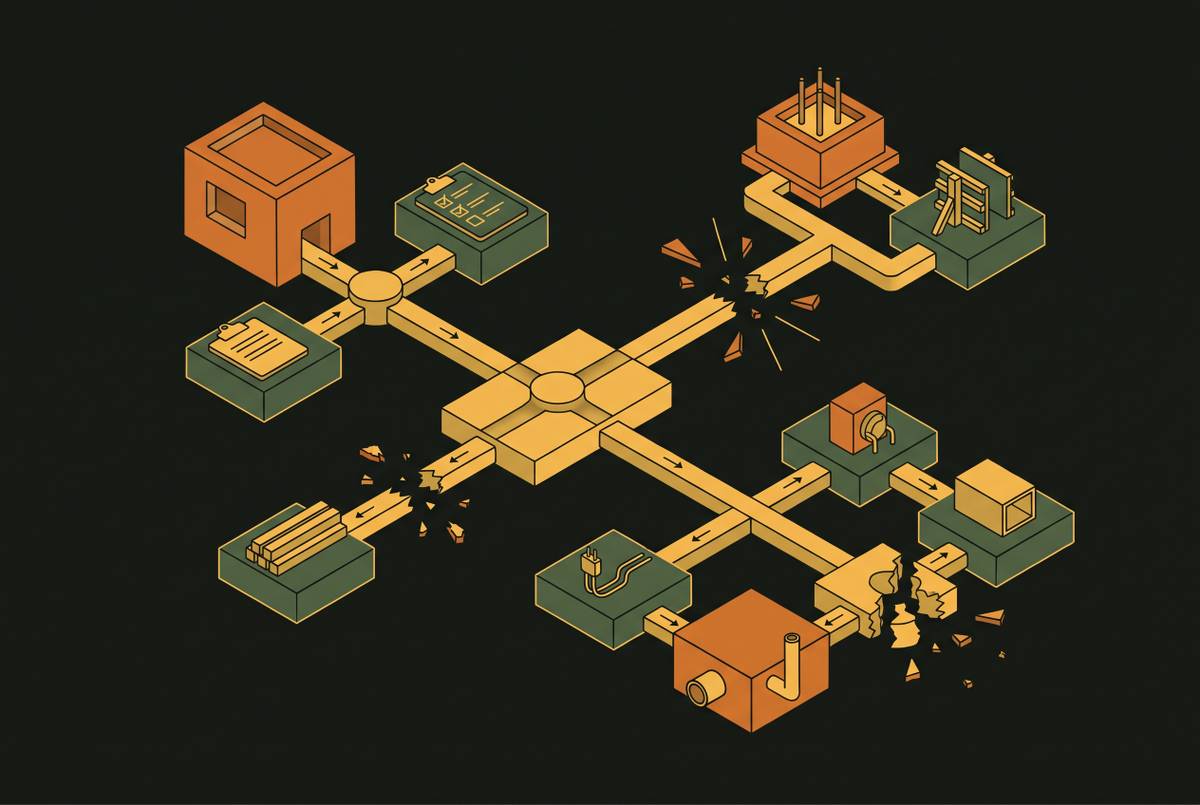
A concrete pour goes fine, and nobody notices that the subcontractor's insurance certificate expired two weeks earlier. The certificate was on file. Someone received it, filed it, and moved on. The process had no mechanism for checking expiry, no trigger for renewal, and no reason to look at the document again until an incident forced the question. By then the cost of the answer exceeds the cost of the pour.
This is the structural diagnosis in one scene. The work itself is document-shaped: insurance certificates, lien waivers, change orders, pay applications, RFIs, submittals, daily reports. Every one is a file with fields, a date, and a counterparty, and every one exists inside a workflow that was built for smaller job counts and simpler document chains. The coordination load has compounded far beyond what those workflows were designed to carry. The production-real AI use cases in construction in 2026 sit exactly here, in back-office automation, estimating, document search, jobsite photo documentation, and computer-vision safety review. These are the unglamorous functions, and they are where the structural overload is most visible and most measurable.
Labor scarcity compounds the problem. Newer staff lack the experience to interpret document interdependencies consistently, so a process that was already fragile under experienced hands becomes unreliable under newer ones. The consequence is not inefficiency in the usual sense. It is risk that accumulates invisibly. An expired insurance certificate, an unanswered change order, a pay application assembled from incomplete lien waiver data: these are not field problems. They are process-design failures that become financial problems.
What "the process" actually looks like when you map it rather than describe it
There is a consistent and material gap between how a back-office process is documented and how it actually runs, and closing that gap is the prerequisite for any redesign worth doing. The canonical illustration: a procure-to-pay cycle gets mapped in practice rather than from a process document, and the mapping reveals that procurement was pulling vendors from an external spreadsheet not connected to the approval system. The declared workflow said one thing. The actual workflow ran on a shadow data source the system never saw.
The pattern repeats across construction back-offices. Change-order workflows that teams describe as tracked in the project management system actually live across email threads, a shared drive, and verbal follow-ups. Subcontractor compliance records are assumed current because a certificate was received, with no process for checking expiry or triggering renewal. Pay application assembly depends on one person's memory of which subcontractors have outstanding waivers. In each case the official description and the operating reality have drifted apart, and the drift is invisible to anyone not actively looking for it.
The evidence-collection challenge in a process audit mirrors the data problem in an AI pilot. Testing is rarely the bottleneck. Finding and assembling the supporting documents scattered across inboxes, drives, and spreadsheets is. A process audit is asking four questions: where does the work actually hand off, who holds the decision versus who holds the paperwork, which steps exist because someone once needed them and never removed them, and where does the clock stop while someone chases an answer. Those questions cannot be answered from a process document, because the process document is what the work was supposed to be, not what it became.
The three back-office workflows where the structural failure costs the most
The highest-cost structural failures concentrate in three workflows: subcontractor compliance, change order and RFI management, and pay application assembly. All three share the same failure shape. The decision is fast, and the paperwork and chasing around it are slow.
Subcontractor compliance is pure record-keeping at its core: every active sub, every required document type, every expiry date. Yet the process typically has no automated trigger when a certificate lapses. Nobody notices the gap until an incident forces the question, and by then the cost of the answer exceeds the cost of the pour. The risk is not in the decision of whether to let a non-compliant sub work. That is a human call. The risk is in the tracking discipline that ensures the decision is ever presented.
Change order and RFI chasing has the same shape. Every change order and RFI has a sent date, a required response date, and an owner. The information exists, but it is distributed across systems, emails, and memory. Unanswered change orders turn into unbilled work, and unbilled work turns into a dispute at closeout. The financial consequence is not the delay itself but what the delay conceals. The single highest-return task in back-office redesign is producing a weekly table: item, job, days outstanding, who owes the answer, dollar exposure. The value is not in the table. It is in making the invisible visible on a fixed cadence.
Pay application assembly is assembly work: pull the schedule of values, current period costs, lien waiver status for each sub, flag exceptions. Missing waivers, line items that moved unexpectedly, retention math that does not tie. When the assembly is done from memory or incomplete records, the package that goes to the owner or lender carries embedded errors that surface later as disputes. Across all three workflows, the decision requires human judgment and happens quickly. The paperwork, tracking, and chasing requires no judgment and happens slowly. The process was never designed to separate those two things, and that failure is structural, not personal.
Why layering automation onto these workflows makes the failure faster, not slower
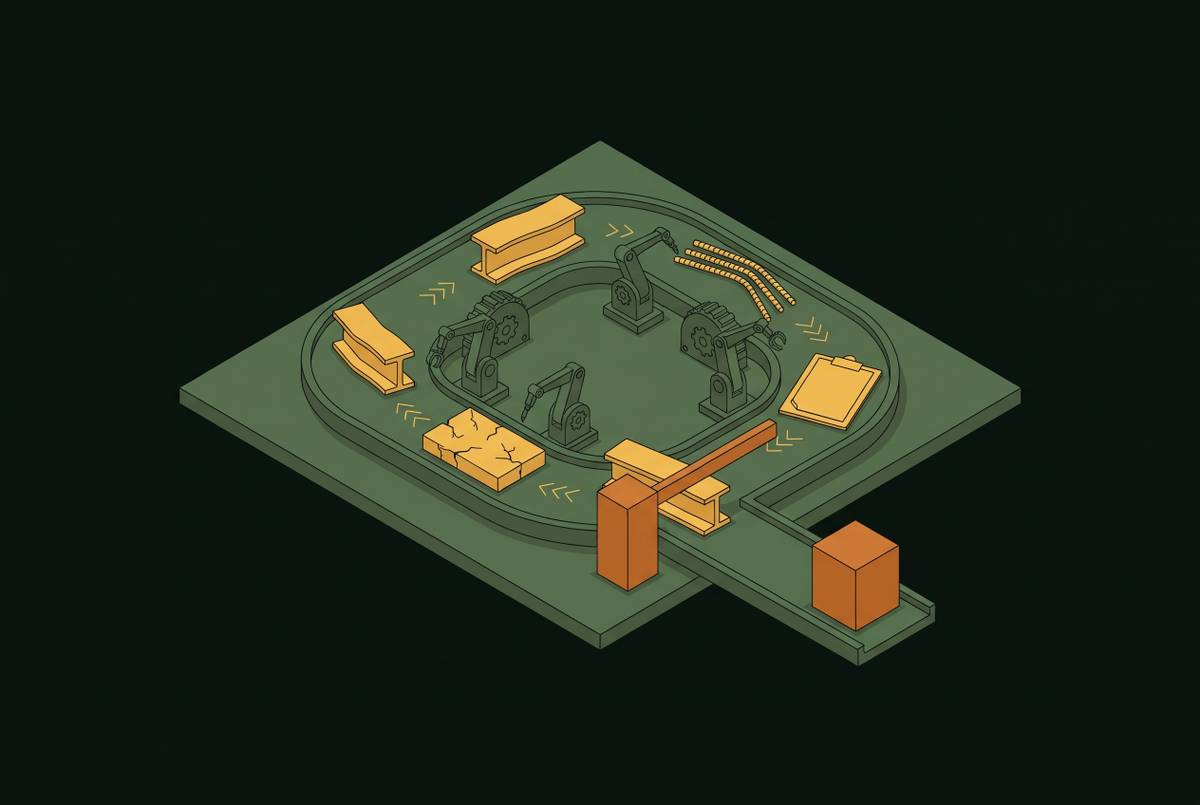
Automating a broken back-office process does not fix it. It executes the broken sequence faster and at higher volume, making the underlying failure harder to catch and more expensive to unwind. If the subcontractor list an automated compliance tracker pulls from is stale, the system produces confident, timely output built on wrong data. The automation adds velocity to the error, not a correction.
The data fragmentation problem is structural, not incidental. The binding constraint on AI in construction is data quality: data scattered across spreadsheets, email, scheduling tools, ERPs, project-management platforms, and field apps prevents any AI from accessing what it needs in a form it can reliably use. The platform-level evidence bears this out. Construction leaders who have deployed AI report that only a minority have met or come close to meeting their AI goals, a gap that reflects not tool failure but process-substrate failure. Pilots impress in demos and collapse when confronted with the exception-heavy, document-intensive reality of live construction back-office operations. The demo runs on clean, curated data. The production environment runs on what actually exists.
The objection worth addressing is straightforward: "we just need better AI tools." The answer is that the tools available in 2026 are production-capable for exactly these workflows. The bottleneck is not the model. It is the process the model is asked to run on. A better tool pointed at a broken sequence produces a faster broken sequence. The failure moves more quickly toward its financial consequence, and the confidence of the automation makes the error easier to miss.
What redesign from first principles actually requires before any tool is chosen
Redesigning a construction back-office from first principles requires mapping how work actually flows before any decision about what to rebuild or what to deploy. The first question is not what should be automated. It is where the clock actually stops. The audit is the act of following a specific document type through its full lifecycle and noting every place it waits for a person, a system, or an answer.
A process audit surfaces specific things in construction back-offices. Shadow data sources: spreadsheets, personal inboxes, or shared drives that the official system does not see but that the actual process depends on. Chasing steps that exist because no upstream discipline produces reliable output on a known schedule. The chase is a symptom of a missing commitment, not a workflow in itself. Handoffs that are verbal or implicit, with no record that the handoff occurred or what state the item was in when it moved. Steps that exist for historical reasons and no longer serve the process: compliance steps added after a past incident that were never evaluated for current relevance.
The audit must trace data to its origin, not just its destination. The field generates the data the back office needs. If teams are producing accurate labor, equipment, and material tracking in the field, the back office gets a true job cost in real time. If they are not, the back office fills gaps with estimates and memory. The redesign decision follows from the audit, not the other way around. Which steps require judgment and relationship, which are pure assembly, which are pure tracking: the separation of those categories is the architecture of the rebuilt process.
The design principle that emerges is simple. The AI-handled side owns the paperwork and the deadline. The human side owns the risk and the relationship. Nothing goes to an owner, a lender, or an insurer without a human approval step. And the starting point is the most painful specific process, not a platform strategy, not a roadmap. That is what produces a live rebuilt process in weeks rather than a pilot that never reaches production.
What production-grade back-office redesign looks like once the process is mapped
Once the process is mapped and the structural failures located, the rebuilt version separates document-and-deadline work from judgment-and-relationship work at every step. That separation is what makes the rebuilt process both faster and more reliable than the original. Subcontractor compliance, redesigned, holds a live record of every active sub, every required document, and every expiry. Not a spreadsheet someone updates, but a system that triggers a renewal chase before the expiry, drafts the email for human approval, and logs the response. The AI-handled side owns tracking, expiry detection, and draft outreach. The human side owns the decision of whether to let a non-compliant sub continue working. Change order and RFI management, redesigned, produces the weekly table automatically from the project management system and email record, not from someone's memory. Follow-up drafts for items past due go to a human for approval before they go to the sub or owner. The AI does the assembly and the timing. The human does the judgment. Pay application assembly, redesigned, pulls the schedule of values, current period costs, lien waiver status, and retention math automatically, with exceptions flagged: missing waivers, unexpected line-item movement, arithmetic that does not tie. The package goes to a human to sign. The three hours of assembly before the signature are recovered.
In 2026, construction platforms can trigger AI from live project events: an RFI creation, a daily log submission, a change event. A rebuilt process is designed to use that capability, not to replicate the old sequence with a chatbot in front of it. Terminal Use operates on exactly this method. The firm starts with a process audit that shows exactly how the process runs today and where it hurts, before deciding what to rebuild first, and targets a live first rebuilt process within weeks. That is the operational discipline the method requires: the design comes before the tool, and the map comes before the design.
The conditions a rebuilt back-office process must meet to stay reliable under production load
A rebuilt back-office process does not stay rebuilt on its own. It requires ongoing discipline in three areas that construction back-offices routinely declare but rarely maintain: change-order record completeness, daily-log discipline, and document-control consistency. Change-order records are the foundation. The rebuilt process depends on contemporaneous, complete records. A change that is not recorded completely when it happens cannot be reliably assembled into a pay application or disputed claim later. The AI can only work with what the record contains. Daily-log discipline is equally foundational. The field generates the data the back office depends on: labor, equipment, materials. If that generation is inconsistent, the back-office process built on it is inconsistent regardless of how well it was designed.
Document-control consistency is the third condition, and it is the one most often dismissed as administrative formality. Consistent naming conventions and metadata are not formalities. They are the conditions under which document search, RFI drafting, and contract review can be trusted. Without them, the AI produces output that looks confident and may be wrong. The honest picture on AI scheduling and forecasting belongs in this same frame. Scheduling AI is described as emerging with high interest and limited deployment, because optimal-on-paper plans meet trade, weather, and change-order reality. A rebuilt back-office process should not be designed around capabilities that are not yet production-grade. Energization and grid readiness are becoming back-office disciplines as well: power availability, long-lead electrical equipment, and energization sequencing are readiness problems for large development and data center projects, and a rebuilt process needs to account for where those inputs originate and who owns them.
The objection worth closing on: "this sounds like it requires perfect data before you can start." The answer is that no process audit starts with clean data. It starts with the data that exists, maps where it breaks, and rebuilds from the specific painful point, not from a platform-wide data-quality initiative that never finishes. The goal is not a perfect process. It is a process that fails visibly rather than silently, so that the human on the judgment side can catch and correct. That is what designed means, as opposed to inherited and never examined.