Rebuilding Construction Procurement Workflows With AI Agents
AI agents amplify existing procurement problems unless you redesign workflows first.
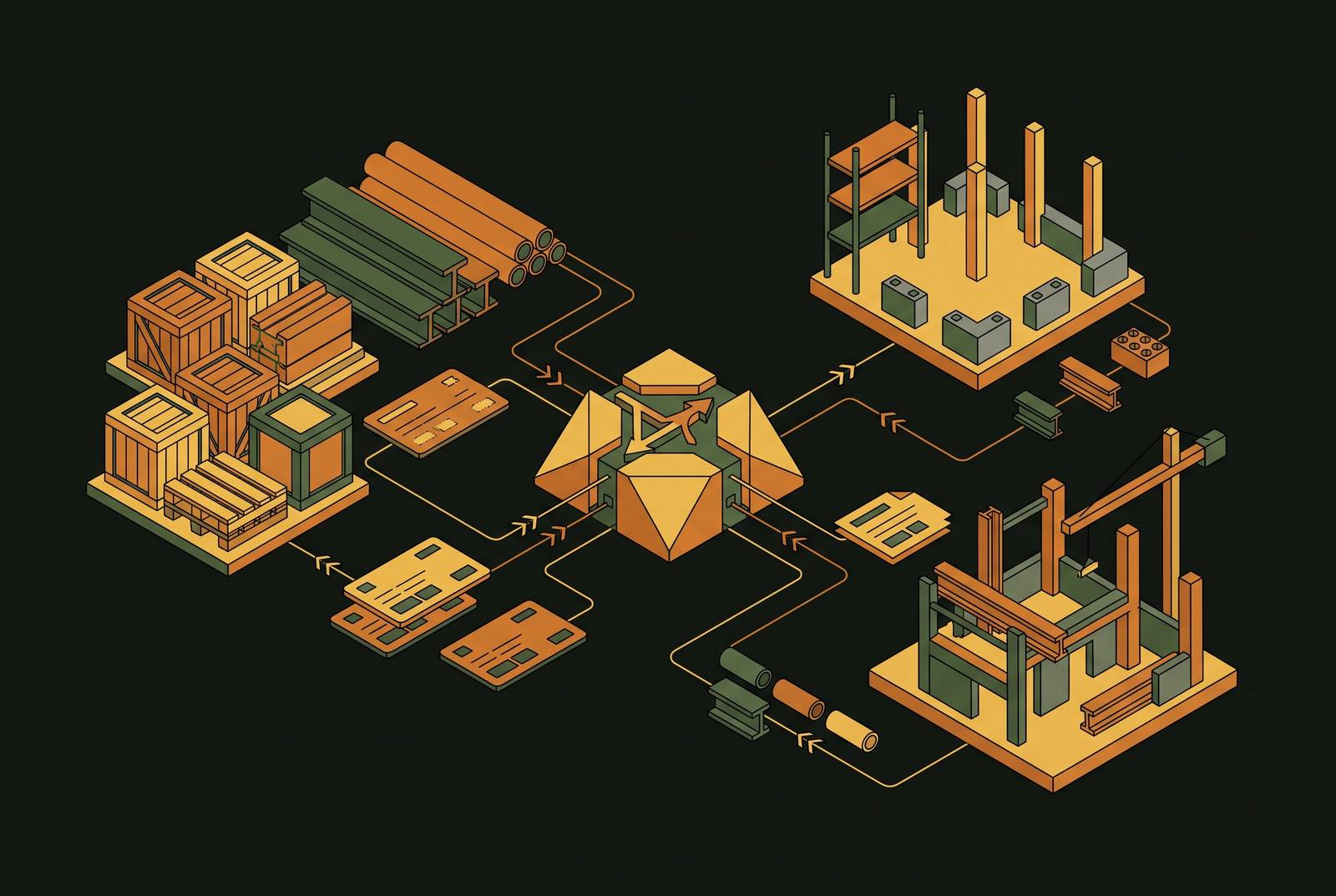
Construction procurement does not fail because a supplier is slow or an estimator makes an error. It fails at the handoffs: the moment scope passes from estimating to the project team, and again when the project team's buyout decisions reach finance for cost coding. Each group works from its own interpretation of the same job, and nothing forces those interpretations to match. The dysfunction lives in the coordination model itself.
Subcontractor onboarding sits in one system. Insurance validation sits in another. Safety documentation and payment terms sit in two more. No individual piece of software closes the gaps between them, because the gaps are not a software problem. They are a design problem: the process was never built so that these pieces talk to each other.
The failures rarely look dramatic from the inside. A supplier takes three extra days to respond. A quote comes back with unclear inclusions. A confirmation never arrives, and nobody notices until the delivery date is already blown. A change gets made verbally on site and never makes it into the file. A procurement package sits "nearly ready" for two weeks, then slips again. None of these individually sinks a job. Together, repeated across every trade and every package, they are what procurement on a construction project actually feels like.
Market conditions have raised the price of these small failures substantially. Switchgear now carries lead times of 12 to 24 months or longer, and large power transformers run 30 to 36 months or more. Tariff exposure on imported electrical and mechanical components adds another layer of volatility on top of those timelines. A missed handoff that once cost a week now costs a quarter, sometimes more. Teams still rely on supplier quotes that expire before award decisions get made. They treat a stated "availability" window as though it were a guaranteed delivery date. They price tariff-sensitive imports without building in the risk that the tariff changes before the order ships. Under today's lead times, each of these habits is a much more expensive mistake than it was five years ago.
All of this, the outreach, the pricing confirmations, the buyout coordination, still runs on phone calls, email threads, and spreadsheets passed between people who each hold a different version of the truth. That is the baseline construction procurement operates from before anyone introduces artificial intelligence into the picture.
Layering AI onto this process makes the dysfunction faster
Putting AI agents on top of a fragmented, email-driven procurement process does not fix the fragmentation. It speeds it up. Agents execute at a volume and speed no human coordinator can match, and that speed exposes every structural weakness in the underlying process faster than a person ever would.
BCG's 2026 analysis of AI in procurement finds that the organizations capturing the most value from AI are not the ones running better models. They are the ones that redesigned their processes end to end before asking agents to run them. BCG's analysis also finds that organizations that simply layer agents onto their existing workflows capture only a fraction of the value available. The lesson for construction is direct: don't put AI agents on top of a process that is already unstable or fragmented, because an agent amplifies whatever the process does, including its failures.
Much of this comes down to data. Most organizations discover, usually later than they would like, that having data and having AI-ready data are two different conditions. An agent reading procurement records that are stale, scattered across disconnected systems, or simply inconsistent from one project to the next will still produce a confident, fluent answer. That answer will often be wrong, and it will look no different from a correct one until someone downstream acts on it.
Construction procurement makes this risk concrete. Picture a cost impact agent, a schedule impact agent, and a contract clause agent, each assigned to its own slice of the workflow. These agents can only coordinate usefully if the data connecting them, scope definitions, budget lines, actual commitments, is governed and consistent across estimating, project management, and finance. Where that data is fragmented, as it is on most jobs today, the agents will not just make isolated errors. They will disagree with each other and with the facts on the ground, each one confidently wrong in a different direction.
Some operations leaders will point to their existing technology stack and argue the fragmentation is already solved: platforms like Procore, Autodesk, and Primavera are already in place, so the data problem is handled. Those platforms centralize documents effectively, but storing a file is not the same as chasing a response, catching a missing attachment, or compiling field data without someone prompting it. Digitizing a process is not the same as redesigning it, and no amount of document storage substitutes for the latter.
What redesign means for a source-to-pay procurement workflow
Redesigning procurement for agents means rebuilding the source-to-pay workflow around defined handoffs, governed data, and clear decision authority, so that when an agent executes a step, it amplifies a process that actually works rather than one that doesn't.
BCG describes what this looks like in practice: redesign the full source-to-pay workflow, applying AI agents to supplier identification, negotiation, contract management, and the rest of the chain, as an integrated workflow connecting data, decisions, and execution. For a construction firm, that means closing the handoff gaps described above before any agent touches the process. Estimating, buyout, supplier management, and cost coding all need to work from the same definition of scope, the same quantities, and the same understanding of what has actually been committed.
Governance belongs inside the redesign, not bolted on afterward. In construction, an agent that sends out an unapproved RFI response has created a liability. Checkpoints for high-stakes actions, change order approval, procurement releases, contract redlines, need to be built into the workflow as structural requirements, the same way a submittal review step is structural.
Data cleansing belongs in the same category. It is part of the redesign itself. BCG's 2026 analysis points out that data cleansing agents can be deployed specifically to catch not just obviously wrong entries but data that looks plausible yet doesn't match historical benchmarks, such as a quote that seems reasonable but is substantially below everything else on file. BCG estimates that roughly 70% of the effort in a typical AI project needs to go toward people, organization, and process redesign. Data quality work is part of that 70%, handled as an ongoing agent task rather than a box checked before the project begins.
Sequencing decisions follow the same logic. BCG's five-step framework states that the choice of which workflow modules to replace first should rest on which agents get deployed first, and that choice in turn should rest on business value and readiness rather than on which piece looks easiest to automate. For a construction firm, that means the right starting point is the highest-volume, most auditable sub-process on the books.
Where AI agents deliver reliable value in construction procurement
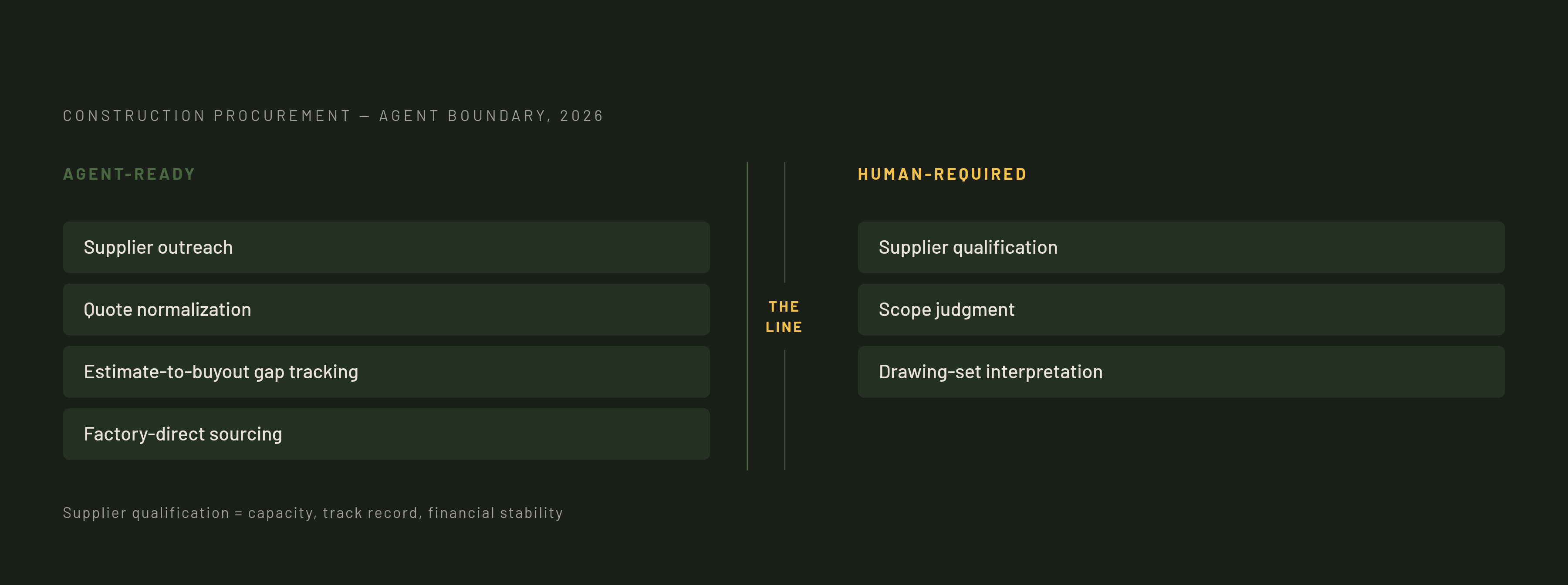
Once the workflow has been rebuilt around clean handoffs and governed data, agents earn their keep in the highest-volume, most repetitive coordination work: plan-set Q&A, quote normalization, tracking the gap between estimate and buyout, and supplier outreach. They are not yet reliable for scope judgment or supplier qualification, which still call for a person who knows the trade and the market.
The clearest, most dependable value available in 2026 sits in three places: plan-set Q&A, quote comparison, and connecting an accurate takeoff to factory-direct buyout. It does not yet sit in replacing human judgment about which supplier can actually perform or how a drawing set should be interpreted.
A few specific capabilities hold up under scrutiny. Automated supplier outreach can send structured quote requests, track who has responded and who hasn't, and pull the results into a format that can actually be compared, instead of a buyer managing all of that by memory and inbox. Quote normalization takes submissions that arrive in different units, by unit price versus bundle, freight included or excluded, and converts them into one apples-to-apples comparison. Estimate-to-buyout gap tracking watches the distance between what a job was estimated to cost in materials and what buyout is actually running, flagging a quote that exceeds budget before the job starts rather than after the purchase order is signed. Factory-direct sourcing matches material requirements against factory-direct suppliers, cutting out distributor markup. Quotr Procurement is a live example of this last model, where the accuracy of an AI-generated takeoff carries through into buyout accuracy, not just into a more precise estimate.
Beyond procurement narrowly, construction project management more broadly already uses agents for RFI drafting, submittal review, bid analysis, daily logs, and schedule risk detection, with a human approving every decision that carries real stakes. The agent drafts and proposes. A person reviews and approves.
The strongest version of this setup is several specialized agents, a sourcing agent, a risk agent, a compliance agent, a cost impact agent, sharing context and handing work to each other. Procurement tasks stretch across weeks, and that requires memory: knowing that Supplier A failed a compliance check three weeks ago, that the budget got revised last week, and that a stakeholder raised an objection in the second round of negotiation. A single general-purpose assistant, asked fresh each time, cannot hold that thread. BCG's 2026 modeling finds that this kind of architecture, running inside a redesigned process, can free up 60% of buyer capacity and optimize sourcing decisions across more variables, faster, than any human team working with conventional software could manage.
The honest limit deserves to be stated as clearly as the capability. Supplier qualification, judging a subcontractor's capacity, track record, and financial stability, still requires a person's judgment. That limit is named directly in current assessments of what these systems can do.
Why governance and human-in-the-loop design matter in this environment
The real constraint on autonomous procurement agents in construction is governance. Without clear escalation paths, defined approval thresholds, and maker-checker workflows built into the design from the start, agents create new liability rather than removing operational risk.
Construction's sequencing makes the stakes unusually high. A delayed subcontractor package rarely stays contained to one trade. It can push back an inspection sign-off, throw off fire strategy coordination, create conflicts during commissioning, and freeze work fronts downstream that were never directly involved in the original delay. An agent that takes an unapproved action inside that kind of chain reaction does not reduce the damage. It compounds it.
The platforms built for this environment reflect that reality by design, embedding human-in-the-loop review by default and adding maker-checker workflows for the actions that carry the most risk: change order approval, procurement releases, contract redlines. The agent drafts and proposes the action. A person reviews it and decides whether it goes forward.
BCG is direct that leading this kind of redesign is a job for the CEO or COO, not for a procurement department working alone, because end-to-end redesign reaches into finance, operations, and overall enterprise strategy. Governance, in this context, is a question of organizational design.
The harder barrier is cultural. BCG estimates that roughly 70% of the effort on a typical AI project needs to go toward people, organization, and process work rather than technology. Procurement leaders speaking at a recent BCG event described these organizational challenges as far more serious obstacles than the technology or the algorithms themselves.
A reasonable objection follows: if a human has to approve every consequential action, what has actually been gained by adding an agent? The agent absorbs the volume, the digging through inboxes, the drafting, the flagging of discrepancies, and leaves the person to make the decision instead of also doing all the legwork that decision depends on. That is faster than the current model, where a human does both. The return on this kind of investment comes from compressing the work.
One more piece belongs here and deserves to stand on its own: every agent action should be logged and traceable. That matters for internal accountability, and it matters because construction disputes routinely come down to exactly this question, what was known, when, and by whom.
Sequencing the first agent deployment
The organizations making genuine progress with AI in procurement follow a recognizable pattern. They choose one high-volume, auditable sub-process, redesign it end to end for agents, show that it works, and only then expand to the next piece. They do not attempt a platform-wide transformation before a single workflow has proven itself.
BCG's framework lays out the sequence: move past simple copilots quickly, prioritize the workflows and decision points with the highest impact, redesign around the workflow itself rather than around a piece of software, build the data and governance foundation early, and only then scale toward a hybrid model where humans and agents share the operating rhythm, once the first use cases have shown real results.
For construction procurement, the best places to start are supplier quote collection and normalization, and tracking the gap between estimate and buyout. Both are repetitive, well-defined, and measurable against a clear standard: did the agent catch a budget overrun before the order was placed, or didn't it?
Before deciding what to deploy, the process needs an honest audit. That means mapping how quotes come in today, how they get compared, where scope discrepancies get caught (or slip through unnoticed), and how commitments actually get recorded once a decision is made. The audit shows where the process breaks in practice, which is often a different answer than where stakeholders assume it breaks.
Data readiness gets assessed during that same audit, not assumed beforehand. The gap between having data and having AI-ready data is not theoretical. Procurement information scattered across email threads, expired quote PDFs, and file-naming conventions that change from project to project cannot feed an agent reliably until someone structures and governs it first.
Suffolk Construction's experience with scheduling illustrates the underlying principle, even outside procurement itself. A meaningful schedule recovery on a life sciences project came from applying AI to one specific, well-defined workflow. The same discipline applies to procurement: pick the workflow, fix it, prove it, then move to the next one.