First AI-First Process Selection in Construction Firms
Choosing the wrong process for AI deployment compounds problems instead of solving them.
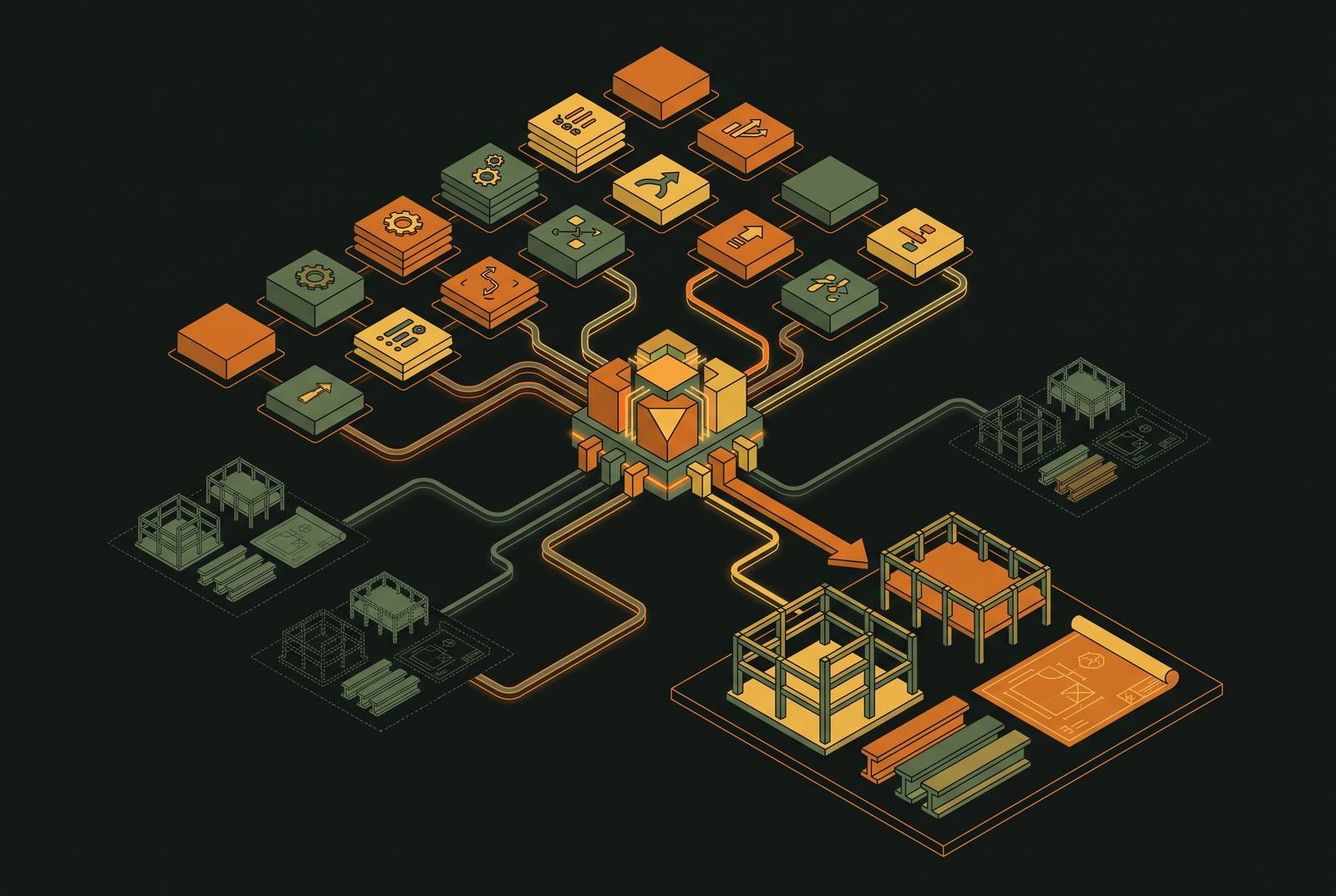
The selection of a first AI deployment is the most consequential operational decision a construction firm will make this decade, and it is usually made on the wrong basis. The process most firms pick is the one leadership can see: a scheduling dashboard, a report generator, a bid preparation tool. The one they should pick is the one where coordination actually fails, where rework and delay quietly accumulate below the reporting layer. That distinction determines whether AI compounds into a durable capability or stalls as a visible artifact that changes nothing about how projects run.
McKinsey's July 2026 report makes the stakes explicit: across dozens of AEC-related domains, the report identifies workflows with materially different automation potential. Most firms will attempt only a fraction of what the report catalogues. Which fraction they choose first, and on what basis, is what separates firms that build proprietary advantage from those that spend a year and an integration budget to automate a process that was never the problem.
The pattern that emerges from direct engagements with engineering, procurement, and construction firms is remarkably consistent. Terminal Use has found repeatedly that the process nominated first for AI deployment is usually one someone already wants to fix for political or visibility reasons, not the one actually costing the most in rework, delay, or coordination failure. That distinction determines whether AI compounds the problem or solves it.
The selection error is structural, not a matter of ignorance. It follows from how construction leadership sees its own operations. What gets measured gets attention, and what gets attention gets nominated. The problem is that the processes most visible to leadership are rarely the ones where failure is most expensive.
What "structurally broken" means in a construction workflow
A structurally broken process is one where the coordination failure, the data gap, or the handoff breakdown is baked into the process design itself. It is not a matter of individual performance, and it is not a matter of tool capability. The process fails because of how it was conceived, and it would fail regardless of who executes it or what software sits on top of it.
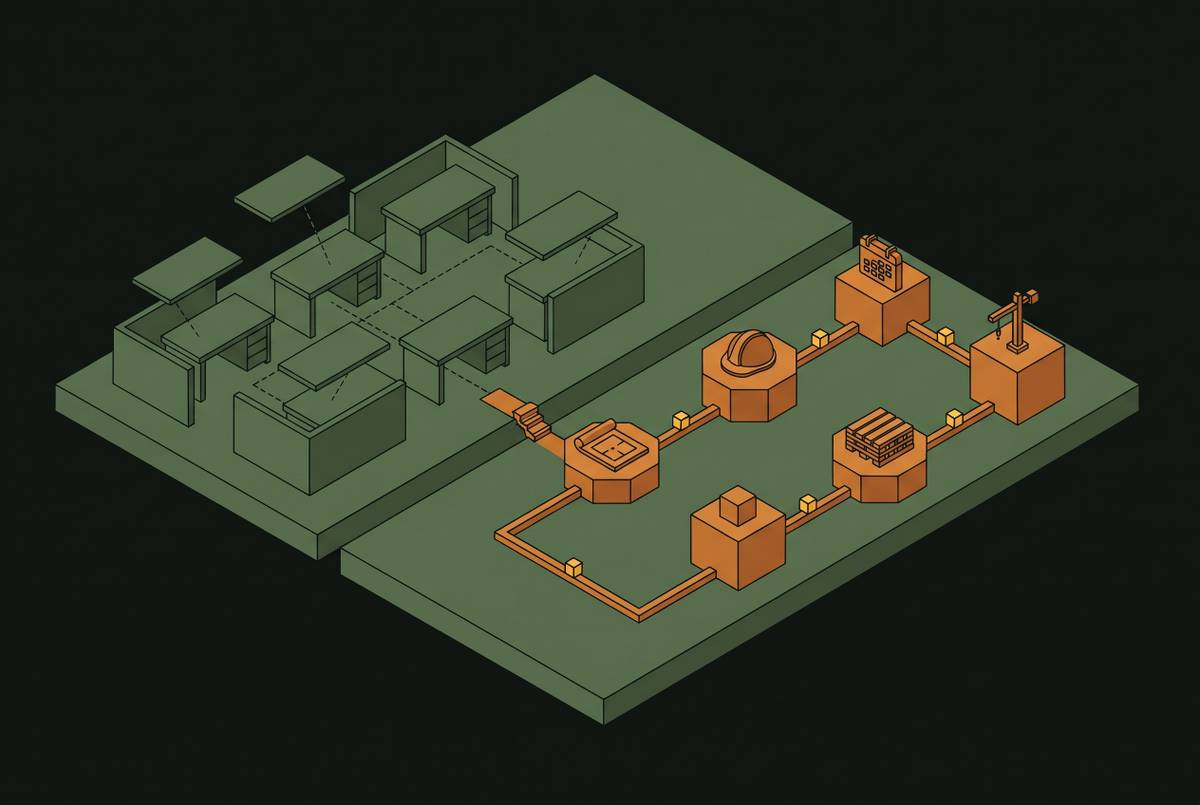
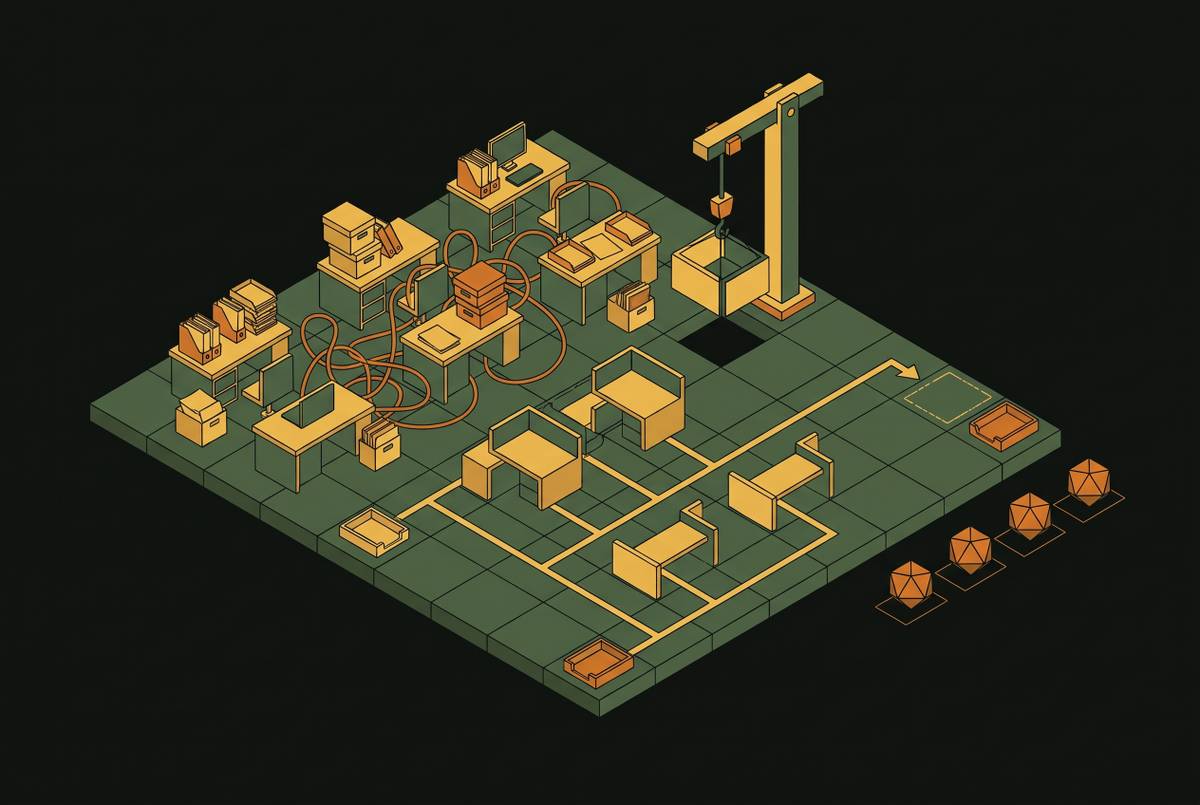
Three markers distinguish structural breakage from the surface dysfunction that exists in every organization. The first is recursion: the same failure appears across projects and teams, not just on one job or with one crew. The second is location: the failure occurs at a handoff between roles, systems, or phases, not inside a single function where one person controls the inputs and outputs. The third is workaround dependence: the people closest to the process have developed compensating behaviors that are themselves load-bearing, meaning the workaround has effectively become the process and the formal process design no longer describes how work actually gets done.
The diagnostic test is straightforward. Show the process running today, in real conditions, with real people, not as it appears in a flowchart or a project management system. Where the flowchart and the reality diverge is where structural breakage lives. Flowcharts describe how processes were designed. Reality reveals how they actually survive contact with the field, with supply chains, with subcontractors who do not read the schedule the way the scheduler intended.
The four construction processes where structural breakage is most concentrated
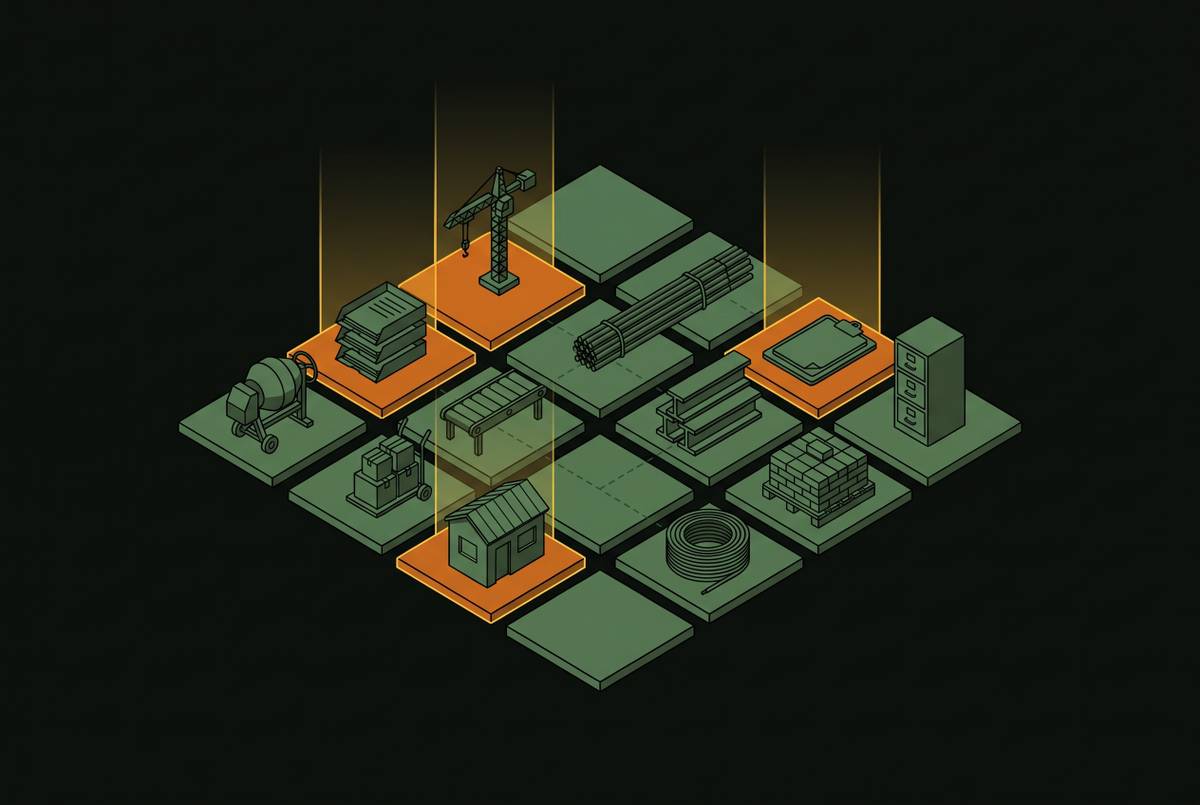
Across construction operations, four processes consistently exhibit all three markers of structural breakage: procurement and materials tracking, subcontractor coordination and handoffs, progress reporting, and commissioning and closeout documentation. Each is a legitimate candidate for the first AI-first rebuild, not because each is inherently broken in every firm, but because the design of each one embeds the conditions under which breakage reliably occurs. They are handoff-heavy, field-dependent, and data-poor in exactly the ways that produce recursive failure.
Procurement and materials tracking fails first on the gap between the purchase order record and field reality. Without real-time tracking, teams cannot reliably know whether materials will arrive when needed, whether substitutions will be required, or how a delay in one delivery cascades into downstream trades sitting idle. The reconciliation between them is manual, and it is where time disappears. Field Materials developed AI agents that process vendor quotes, purchase orders, delivery records, invoices, and inventory data, and automate three-way matching of delivery slips to POs and invoices. If the process worked as designed, no one would have needed to build a dedicated system to reconcile its records.
Subcontractor coordination and schedule handoffs exhibit the same breakage through a different mechanism. Schedule tools capture intent, not achievability. The real risk lives in whether the right crew, materials, and access conditions align at the right time, and that alignment is managed through informal coordination that leaves no data trail. Nothing captures that conversation, so nothing can be learned from it, so the same misalignment recurs on the next phase and the next project.
Progress reporting is broken by its own design assumption. Manual progress reporting lags real site conditions by days or weeks. The actual work, moving the project forward, was happening somewhere else.
Commissioning and closeout documentation breaks differently, and more insidiously. The handoff breakdown here sits between field teams generating evidence and document controllers managing it. Neither group has visibility into whether the other's output will satisfy the eventual review.
Why the most visible process is rarely the right starting point
Visibility and structural breakage are negatively correlated in construction. The processes that get the most leadership attention are usually the ones that produce visible outputs: schedules, reports, bids. The processes causing the most damage operate below the reporting layer, in procurement, coordination, and field execution where no dashboard captures the cost of failure. Leadership does not see the three weeks of coordination that the schedule's latest revision silently absorbed.
The mechanism behind this misalignment is workaround cover. Visible processes already have workarounds that make them look functional. Structurally broken processes that operate below the reporting layer have no such cover. Their failure is visible only to the people living inside it.
McKinsey's July 2026 report sharpens this point without necessarily intending to. It identifies bid/no-bid analysis, estimating, and proposal drafting as the near-term automation targets. These are exactly the visible, output-facing processes that leadership can point to when asked what AI is doing. The same report simultaneously identifies data entry, invoicing, and equipment inspection as the functions seeing the most structural change. Those are less visible but more foundational. The report documents both the temptation and the trap in the same findings.
Automating a visible process that is propped up by informal workarounds does not eliminate the workarounds. When the visible layer gets automated, the compensating behavior moves into the automation, embedded and unexamined. This is the mechanism by which automating a broken process makes it worse.
The strongest objection is organizational rather than technical. The difference is whether the AI rebuild can be shown to change an outcome rather than merely report one. The global construction industry sits at a $15 trillion inflection point, and the firms that learn this distinction early are the ones that will own the data and the capability that follow.
How to run the process audit that surfaces the real starting point
The right first process cannot be identified from a list of candidates or a technology assessment. It can only be found by observing how specific processes actually run today, where they hurt, and what the workarounds cost. The audit is an observational discipline, not a survey.
Three inputs make the diagnosis observable. The first is unplanned time: where do people spend time they did not plan to spend? The second is translation points: where does a handoff between teams or systems require a human to manually translate or re-enter information? The third is undocumented workarounds: what do people do that everyone knows about but no one has formally written down? The process cannot run without them, which means the formal process design is already wrong and the real process is the one everyone actually executes.
The data check follows from the observation. A process that meets the audit criteria but has no recoverable data trail is a harder starting point than one with the same pain and an existing, even messy, data record. But the absence of data is itself diagnostic, not disqualifying. It means the data capture is part of the rebuild, and the rebuild starts from the observation rather than from an existing system.
The sequencing test is the practical filter. After identifying candidates, ask which process, if rebuilt from scratch with AI agents at the center, could produce a live operational result in weeks rather than quarters. Long timelines signal either the wrong process or the wrong approach to rebuilding it. The process that takes quarters is either too entangled with dependencies to isolate, or the rebuild is being done as a tool placement rather than a process redesign.
STRABAG SE's approach is instructive here. Mastt's 2026 roundup notes this as a real deployment, not a pilot. The selection logic is precise: pick the phase where observing the process can still change the outcome.
Identifying which of these four processes to rebuild first requires seeing how the failure actually cascades. An operations firm approaching this as a rebuild problem, not a tool placement, will start by mapping where coordination, data, and handoffs are genuinely breaking down, then sequence the rebuild to get a live first process in place within weeks rather than quarters. This is the approach Terminal Use applies in its process audits, where clients show exactly how a process runs today, not describe it, because the gap between the description and the reality is where the selection answer lives.
The organizational context makes the discipline more urgent. Only 11 percent of organizations currently operate agents at full production scale, according to Deloitte's 2025 Emerging Technology Trends study. The gap between adopting AI and operating it as a rebuilt process is where the competitive difference now sits. Running the audit correctly is what closes it.
What a well-chosen first process makes possible that a poorly chosen one forecloses
The first AI-first process sets the data, trust, and capability conditions for everything that follows. A well-chosen first rebuild generates field evidence that changes how the organization thinks about AI. A poorly chosen one generates a dashboard that confirms skeptics' priors and makes the second process harder to justify.
The compounding logic runs on data. When the first AI-first process operates in a structurally broken workflow, it captures data that was previously invisible: procurement timing, coordination delays, field-versus-plan divergence. That data becomes the input for the next rebuild, and the rebuild after that. Starting with a visible process that already has data captures nothing new. It produces a better view of something already understood, which is not the same as producing understanding.
The trust compounding works through outcomes rather than outputs. It demonstrates that AI can change outcomes, not just describe them. The confidence compounds because the next process proposal arrives with evidence attached.
McKinsey's July 2026 report identifies the medium-term advantage as coming from proprietary data: RFIs, drawings, specs, closeout reports. This is exactly the data that structurally broken processes currently lose or corrupt. The first process rebuild is the mechanism for starting to own that data. The firm that rebuilds commissioning documentation first owns a clean closeout record that becomes a training asset for the next project. The firm that automates bid drafting owns a faster bid, which everyone else can also buy.
The stratification runs in both directions. Mastt's 2026 roundup documents firms like Bouygues, STRABAG, and Larsen & Toubro making real operational deployments, not pilots. Firms that delay selection or choose the wrong starting point are not standing still. They are falling behind organizations that are already compounding their data and their capability, and the distance grows with each quarter of indecision.
The practical implication is that the selection decision is not a technology procurement. It is an operational diagnosis that determines what the firm will be capable of building next. Treating it as anything less is how firms end up with AI on top of broken processes rather than AI in place of them. The first process is not the first project in an AI program. It is the decision that determines whether the program exists at all.