Subcontractor Coordination Workflow Breakdown Points
Audit where information breaks in the workflow before automating construction coordination.
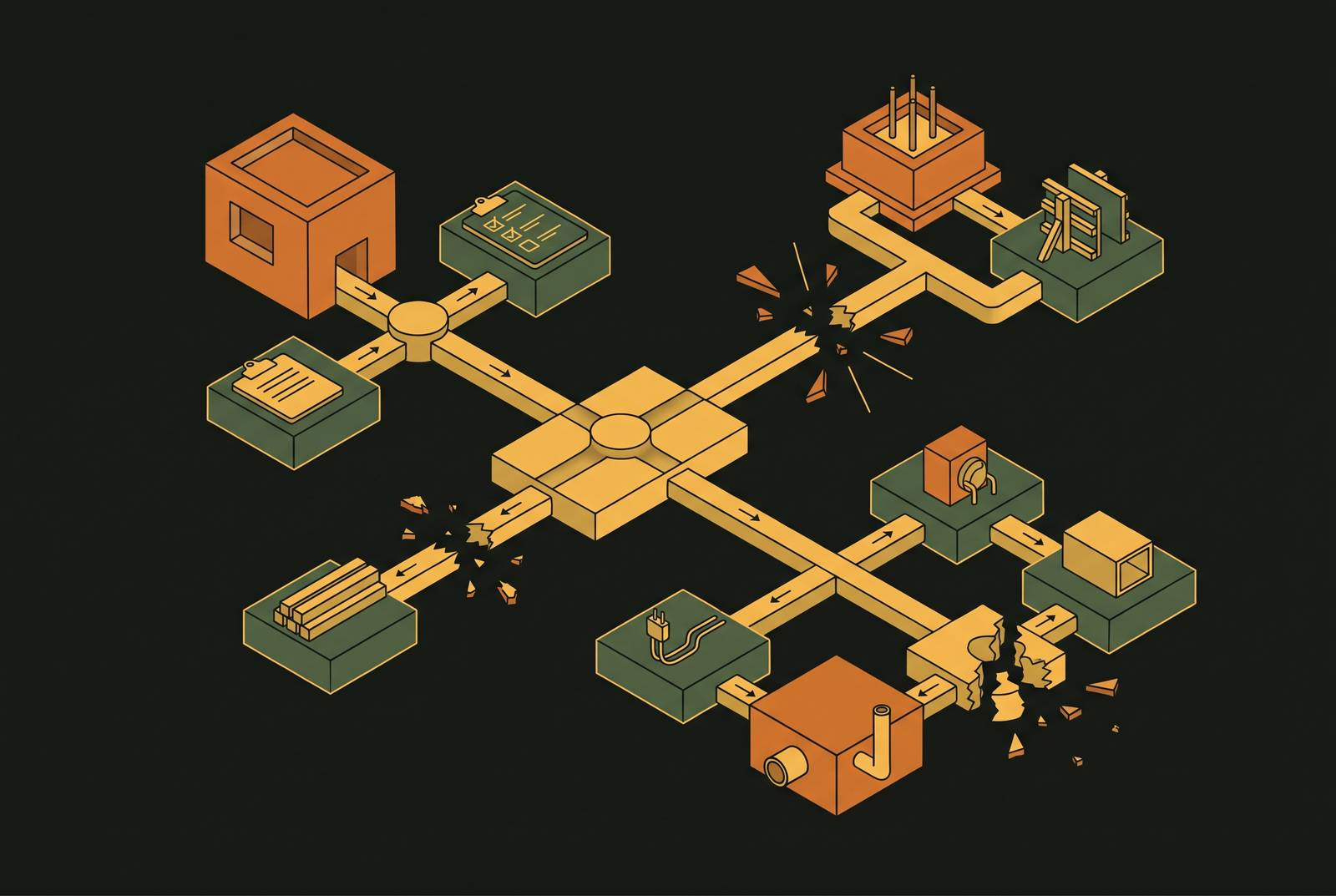
Subcontractor coordination breaks at identifiable points in the workflow. Before deploying AI or automation in construction operations, a process audit should trace schedule currency, notification acknowledgment, scope boundaries, change detection, and subcontractor qualification to find the first broken link.
Why subcontractor coordination is an information-routing problem, not a people problem
Coordination connects the schedule, trades, and documents so each crew knows what to do, in what sequence, and with what current information. Its basic mechanism is information routing. A predecessor event changes what can happen next, and that change must reach the trade whose work depends on it. When the connection holds, crews arrive to conditions that are ready for them. When it breaks, an electrician can miss a revised RFI answer even though the answer exists in the project records.
Most construction software stores information well but still depends on someone noticing a change and telling the affected parties. That manual handoff creates a gap between the project record and the instructions reaching the crew. A document can be current while the workface remains uninformed. Diagnosis requires checking whether the information exists and whether the workflow routes it when the next trade needs it.
Subcontractor performance remains a primary variable because subcontractors perform the preponderance of building work. Poor planning and weak execution are real risks. However, selecting a contractor without validating capacity is itself an upstream system decision, while failing to route a revision is a separate execution failure. Treating both as “bad subcontractors” obscures where the process broke. The same job can have competent people and still lose coordination at specific, identifiable structural points.
How a stale schedule corrupts every downstream coordination step
The schedule supplies the dates and dependencies that drive notifications, sequencing decisions, and crew mobilization. If those inputs are stale, the routing system can work exactly as designed and still issue the wrong instructions. Accuracy must precede speed in this part of the workflow. Automating a notice does not make its underlying start date valid, and a successful delivery does not establish that the workface is ready.
A drywall crew has to wait for framing to pass inspection before it can start. If the schedule shows a drywall start without reflecting that predecessor, a missed inspection does not appear as a constraint on the next crew. The superintendent may then coordinate mobilization against a date that no longer corresponds to a workable sequence. The breakdown begins in the dependency chain, before the notification leaves the office.
A superintendent who re-types the three-week look-ahead every Friday records what was true when it was typed. Two days later, a crew may read dates that no longer match what is happening on site. Until the schedule catches up with the change, every coordination step that uses it risks the same error.
Labor scarcity makes that error harder to absorb. A crew mobilized before conditions are ready may not be available when the predecessor finally clears. The consequence extends beyond the productivity lost on the first visit because the corrected date must now fit the crew’s availability.
Why sending a notification is not the same as closing the coordination gap
Even a current schedule cannot coordinate a crew that never confirms the instruction. Sent, acknowledged, and acted on are different states. Dispatch establishes that a notification left the system, while acknowledgment establishes that the recipient confirmed it. Neither alone establishes that the crew acted on it. A workflow that collapses those states into “communicated” hides the remaining work.
That distinction explains a common silent failure. A superintendent sends a revised start date and believes the trade has been informed. The trade gives no confirmation and assumes the date may change again. Neither brings up the doubt about the date until a crew arrives and finds the site unready. The notification exists, but the alignment it was supposed to create does not.
An acknowledgment loop makes that uncertainty visible. An SLA timer can re-notify the recipient after silence and then alert the superintendent if the gap remains open. The escalation turns an unobserved failure into an exception that a person must address before the workflow proceeds on an assumption.
Requiring an app download and a new account to confirm a Tuesday start creates friction at the point of response. SMS or URL-based confirmation without a login removes that obstacle. A record of who confirmed what and when also turns later disputes into questions about the record, rather than competing recollections of what was sent or received. A visible gap is manageable. A silent one compounds.
Where scope ambiguity at trade interfaces turns into disputes and rework
Even with an accurate schedule and confirmed instructions, work can go unclaimed when each trade thinks it belongs to the other. Scope ambiguity sits at a different layer. It concerns the contractual and physical boundary between crews, where one subcontractor may assume another will provide supports, seal penetrations, remove waste, protect finished work, or arrange testing. Those assumptions can stay hidden until the work is due, even when each subcontractor knows its own core task.
The resulting failures take two distinct forms. A gap occurs when neither subcontractor prices the interface work because each assigns it to the other. An overlap occurs when both price the work and mobilize to perform it. The first leaves an obligation unclaimed, while the second creates conflict at the workface. Neither can be diagnosed simply by checking whether a start notice reached the right person.
Physical interfaces make these boundaries especially consequential. Fire protection and electrical crews may need the same overhead access, while plumbing in a wall cavity must precede drywall. Penetrations create another boundary between the trade that installs and the trade that seals. Without an agreed sequence, one crew’s installation can force another to remove or relocate work.
Contract terms can amplify that exposure in mission-critical builds when prime obligations flow down by incorporation and subcontract milestones place upstream schedule risk on a trade that did not control the relevant decisions or permits. Reusable scope templates for common trades, including electrical rough-in, framing, and MEP coordination, reduce variation in how interface responsibilities are written. Early clarification gives the team time to resolve gaps before they affect cost or progress. Once the work is due, the unresolved boundary becomes a dispute or rework.
How coordination systems fail specifically at the moment things change
Clear scopes and a current schedule at kickoff do not guarantee coordination during execution. Setup and adaptation are different system demands. A project may complete inductions, review RAMS, and brief supervisors without an equally thorough way to spot changes as workfaces move and plant activity shifts.
The critical break occurs when a changed condition is not captured as a triggering event. A route changes, a delivery slips, or a design revision alters quantities, but no mechanism identifies who now needs different information. Existing records may remain orderly while instructions diverge from conditions. Automation closes the interval between a change and notification only when the system captures the change and routes it to the affected parties.
An answered RFI illustrates that routing requirement. Every subcontractor whose scope the revision changes needs to receive it. If distribution remains manual, some crews can receive the answer while others continue using the previous plan. The resolution does not reach everyone whose work it changes.
When a topology revision changes equipment quantities on a long-lead job, procurement needs the information within hours, ahead of the revised drawing set clearing review weeks later. Safety coordination has a parallel vulnerability when changed routes, plant activity, and hazard controls are not updated during execution. Competent teams and intact documentation do not close that gap.
What qualification-on-price-alone does to coordination before the project starts
Some execution failures are built into the project before the coordination workflow starts operating. Price-only selection can create a capacity deficit. An overextended subcontractor that has committed its crews to more work than it can staff may arrive undermanned or fail to arrive at all. Every downstream trade depending on its milestone then inherits the delay, regardless of how accurately the schedule records it.
This is a different problem from information failing to reach a capable crew. A current schedule can expose the constraint, and acknowledgment can establish that the contractor knows the required date. Neither creates the missing labor capacity. No in-execution workflow can fully absorb an award decision that depends on resources the selected subcontractor cannot provide.
Prequalification is part of procurement administration that also helps manage the risk of coordination failures. Financial stability, safety records, how the subcontractor did on similar project types, and its current backlog show more than the bid price alone. Capacity validation brings the risk into the award decision while there is still time to identify a disqualifying condition. Importing COIs, licenses, and past performance into subcontractor profiles before bidding also lets qualification and coordination start from the same information.
The financial context reinforces that upstream connection. Hardening surety and insurance markets in 2026 are demanding evidence of formal prequalification programs, safety records, financial discipline, and WIP reporting before approving competitive bond terms. That demand makes coordination risk part of the broader check on whether the work can be delivered. The practical conclusion is narrower than a general call for more careful buying. Coordination begins at selection.
How do you find broken coordination workflows before rolling out AI?
A process audit follows how a coordination step works today and where it breaks down, from pre-award qualification through execution. Reports alone cannot establish that path. A declared schedule or project management report shows how the process is meant to work but may leave out the gap between a change on site and the instruction reaching a crew. The audit’s purpose is to locate that gap before choosing what to rebuild.
For an operations leader applying this map, the first criterion is schedule currency. The audit should establish whether the master schedule functions as a live dependency graph or as a document updated on a cadence. It should then distinguish notification dispatch from acknowledgment and escalation, rather than treating all three as successful communication. These checks separate bad inputs from failed delivery. Bad inputs call for a first repair in scheduling discipline, while failed delivery calls for a first repair in the acknowledgment loop.
The remaining criteria extend beyond message routing. Scope interface clarity asks whether trade boundaries are defined in writing before work begins or discovered at the workface. Change detection asks whether a triggering event reroutes affected information or depends on someone noticing and transmitting it. Qualification asks whether capacity was validated before award. An external process audit can follow those same steps, but its value depends on examining the actual workflow rather than accepting the declared process as evidence of performance.
On small, single-trade, or single-superintendent projects, one person may hold the whole job in their head, and a tool can add friction. Multi-trade, schedule-compressed, or geographically distributed work places greater pressure on these structural points. Work should begin with the specific painful step. Fix upstream first, because automating notifications from a stale schedule only distributes the error faster.