The Pre-AI Process Inventory That Shows Which Construction Workflows Are Worth Rebuilding
Audit workflows before automating them to avoid rebuilding broken processes faster.

Before deploying AI in construction or logistics operations, teams should audit how work actually runs. A pre-AI process inventory checks the evidence, how consistently work is done, the handoffs, and error recovery to tell which workflows are worth rebuilding and which would only fail faster under automation. That distinction makes the inventory the most important pre-AI step.
Why construction AI deployments keep failing despite widespread adoption
Widespread AI adoption in construction has not translated into operational improvement because the underlying processes being automated are already broken. Tool availability is not the central constraint. The gap between Level 2 and Level 4, AI-assisted operations, comes mainly from the need to standardize how work is done. AI readiness begins at Level 3, where processes are documented and consistently followed, approval chains are defined, and routing is standardized. Without that foundation, an AI deployment inherits uncertainty about how work should proceed.
Recording work does not ensure that it is executed through a controlled process. A record assembled after a decision does not establish that the required approval governed that decision. Faster reporting cannot close that execution gap. Automation can then make the same failures happen faster while leaving the problems with approval and evidence in place. The team must distinguish processes that are candidates for redesign from those whose current structure should be discarded.
What a process inventory actually is and what it is not
A pre-AI process inventory is a structured triage exercise that surfaces the gap between declared procedure and actual field execution. It is a field investigation. Its diagnostic object is traceability, including timestamped approvals, version history, change orders linked to contracts, payment application backup, and subcontractor compliance records. The central distinction is when that evidence appears. Evidence generated during execution can support AI redesign, while project history that must be reconstructed manually exposes a process that needs repair first.
An inventory is not a process map, either. A project can maintain procedures, Inspection and Test Plans, method statements, and registers while still suffering repeated defects, missed inspections, uncontrolled drawings, and incomplete handover records. Wu et al.'s 2026 workflow-level framework argues that aggregate metrics, including usage logs, investment figures, productivity changes, and headcount, mask structural changes in how work is allocated and recovered. The inventory follows actual execution to establish whether the process produces usable evidence as work happens or depends on someone assembling it later for review.
The four questions that structure a construction process inventory
The team first checks whether the process generates its own evidence. The inventory team asks the people doing the work to demonstrate this during execution. A superintendent approving a field change without supporting photos or owner authorization exposes an execution gap, even if someone later completes the record. Timing is part of the control itself. The same test applies when a subcontractor submits an invoice before insurance renewal is verified or payroll processes union labor classifications that do not reconcile with jobsite time entries.
The team next checks whether execution is consistent enough to be predictable. Most construction audit failures arise from inconsistent execution. For example, the team asks whether field-change approvals follow the same process across staff or depend on who happens to be present. The investigation must distinguish an occasional deviation from a workflow in which improvisation is the normal way to get work through.
The team then locates where the process breaks, at the task or at the handoff. AI can help with a task such as putting together a report that takes too long to compile. Informal approvals, ad hoc routing, and decisions without records require process redesign first. The distinction extends beyond any single task. Suffolk and MIT's September 2026 study identified six interdependent workflow levers, namely design automation, offsite manufacturing, permitting, scheduling, skilled labor and subcontracting, and supply chain and procurement. Procurement information that cannot support scheduling illustrates why a faster task does not necessarily improve the connected workflow.
Finally, the team identifies who bears the verification and recovery burden when an output is wrong. Wu et al.'s framework warns that producing an output faster can leave more work to do in verification, exception handling, or recovery. The inventory team then asks who would settle a disputed payment application and whether the project history needed to support it is already at hand. If resolving the error requires manual reconstruction, that recovery path needs redesign before AI is introduced.
How to score what the inventory finds without hiding the signals
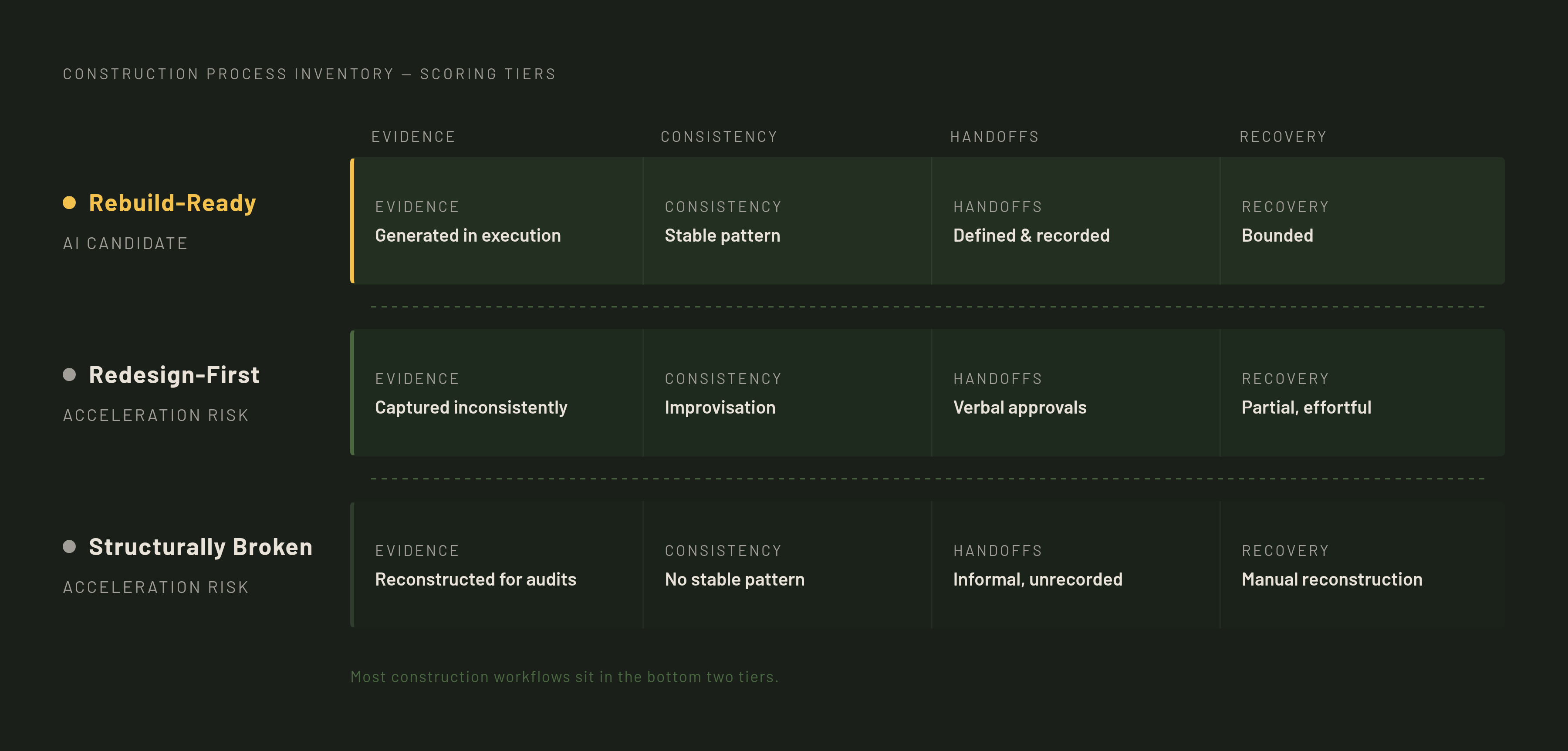
The scoring logic sorts workflows into three categories, which are rebuild-ready, redesign-first, and structurally broken. Numerical grades are not the objective here. A project engineer needs a decision grounded in visible execution that exposes a missing approval chain. Each category reflects what the four questions reveal about evidence, consistency, handoffs, and recovery. A fast task with an undefined handoff does not become ready merely because its potential time savings are attractive.
A rebuild-ready workflow generates evidence during execution, follows a consistent pattern, and has defined handoffs that leave a record. Its verification and recovery burden is bounded and understood. An RFI workflow can fit this category when routing and approvals are defined, lag is measurable, and deviations are exceptions. Repetitive structure then offers a useful starting point. The workflow can move toward AI redesign because its controls and evidence already support dependable execution.
A redesign-first workflow has value, but its structure needs repair before automation. Evidence exists but is captured inconsistently, approvals happen verbally, or the process works reliably only when experienced staff are present. A field-change process that records authorization retrospectively fits this category when the underlying work remains recoverable but resolving omissions consumes substantial time. The team needs to standardize those handoffs and the evidence they require before adding an AI layer.
A structurally broken workflow routinely reconstructs evidence for audits, has no stable execution pattern, and treats failed handoffs as normal. The Avison Young / Buckingham Group case shows how money is at risk when the evidence for payments falls short. The NEC project manager accepted reduced estimates for total earthworks without enough evidence, using excavation figures rather than records that showed how much material had reached its final position. After Buckingham entered administration, the developer could not recover the overpayments. The evidentiary process needed rebuilding from scratch because AI could not substitute for records of the work being certified.
Which construction workflow categories the inventory most often exposes as broken
Procurement and supply chain workflows break when declared timelines diverge from actual equipment lead times. Large power transformers and switchgear can have lead times exceeding an entire construction phase, so an undeclared procurement gap can undermine an otherwise well-managed schedule. The inventory signal is concrete and testable. The team should be able to produce current approved vendors, outstanding commitments, and confirmed delivery dates tied to schedule milestones without reconstructing them manually. For rebuild-readiness, procurement data must be structured so it can feed scheduling and field execution and allow the connected gains described in the Suffolk and MIT study.
Scheduling breaks when the plan expresses intent without supporting a test of achievability. P6 schedules and similar planning tools do not resolve that distinction by themselves. The inventory asks whether schedule data supports simulation and what-if analysis or exists only as a declared plan. For rebuild-readiness, the data must be structured so the team can test schedule risk as well as reproduce planned dates.
RFI and submittal coordination is generally closer to rebuild-ready because there are many requests, they follow a repeated pattern, and their lag can be measured, making AI a good fit to help. It breaks down when approvals are informal. The inventory should establish whether routing and the approval chain are defined, rather than infer readiness from the number of requests processed. This category becomes suitable for redesign when those handoffs are explicit, since an agent that drafts and routes RFIs depends on a defined authority chain.
Compliance and subcontractor documentation often expose a deeper evidentiary failure. Insurance verification, certified payroll, union labor classification reconciliation, and approved vendor status checks are routinely managed through email and manual follow-up. The inventory signal is repeated retrospective assembly of proof that required checks occurred. Rebuild-readiness requires standardized checks and evidence capture during execution.
The workflow-level conditions that determine whether AI redesign will hold
Passing triage establishes candidacy. Wu et al.'s framework proposes six conditions spanning durable net value, meaningful human control, accountability and recovery, and long-term human development through learning, career pathways, and job purpose. A construction workflow must remain governable and recoverable after redesign, while preserving the human capability needed to oversee it. A successful pilot does not settle those questions.
To judge durable net value, the team must weigh the costs of verification and recovery against the time saved in producing the first output. Faster first drafts may need more time from experts to catch AI errors, so the work as a whole may be no better off. Meaningful human control imposes a related requirement. Audit trails, sign-off protocols, and disclosure requirements function only when reviewers retain the capacity to use them. The inventory should check whether experienced staff can spot a wrong output as well as whether someone is in place to approve it.
Accountability and recovery require an error path defined before deployment. The assessment must identify who reviews, who intervenes, and how recovery proceeds within the workflow under consideration. Human development is equally demanding in practice. The framework warns that structural changes to work can erode skills and weaken the integrity of human-AI collaboration. Learning, career pathways, and job purpose are therefore operational concerns in asset-heavy environments where field judgment remains irreplaceable.
Resource-constrained teams have a serious objection to this standard, because they need relief from manual work now. Resource-constrained teams can begin with a narrower investigation. Examining one painful process takes days. Its findings can expose the existing failure that a hurried deployment would accelerate while keeping the initial effort bounded. The inventory is consequently not a one-time gate, but the beginning of the feedback loop through which AI redesign can improve over time.
How do construction teams run a process audit before deploying AI?
The first inventory should start with the process causing the most manual hours, rework, escalations, or compliance exposure. Its scope is one triage decision. The inventory team should work with the people who execute that process and ask them to show exactly how it runs today. The written procedure is only a reference point. The investigation follows what actually happens when a subcontractor misses a deadline, a drawing revision arrives mid-pour, or an approval chain stalls.
Within days, that investigation should produce a clear classification as rebuild-ready, redesign-first, or structurally broken. It should also identify the specific handoffs that need standardization before an AI layer is introduced and distinguish the evidence currently generated from the evidence the process should generate. These are operational deliverables. They show whether the next action is AI redesign, repair of an existing process, or reconstruction of its basic execution controls. They also make the decision inspectable by the people responsible for the work.
After deployment, each redesigned process should feed evidence into a running inventory of what works, what is degrading, and which process should be rebuilt next. Allplan's 2026 AEC AI trends analysis describes data-centric engineering as built on high-quality structured data and feedback loops between design, construction, and operation. The process inventory plays the same role in construction operations. Its continuing task is to test whether the evidence generated by work is good enough to support the next layer of AI.