Stopping the Automation Loop That Keeps Bad Construction Workflows Alive
Automating a flawed process only speeds up its failures.
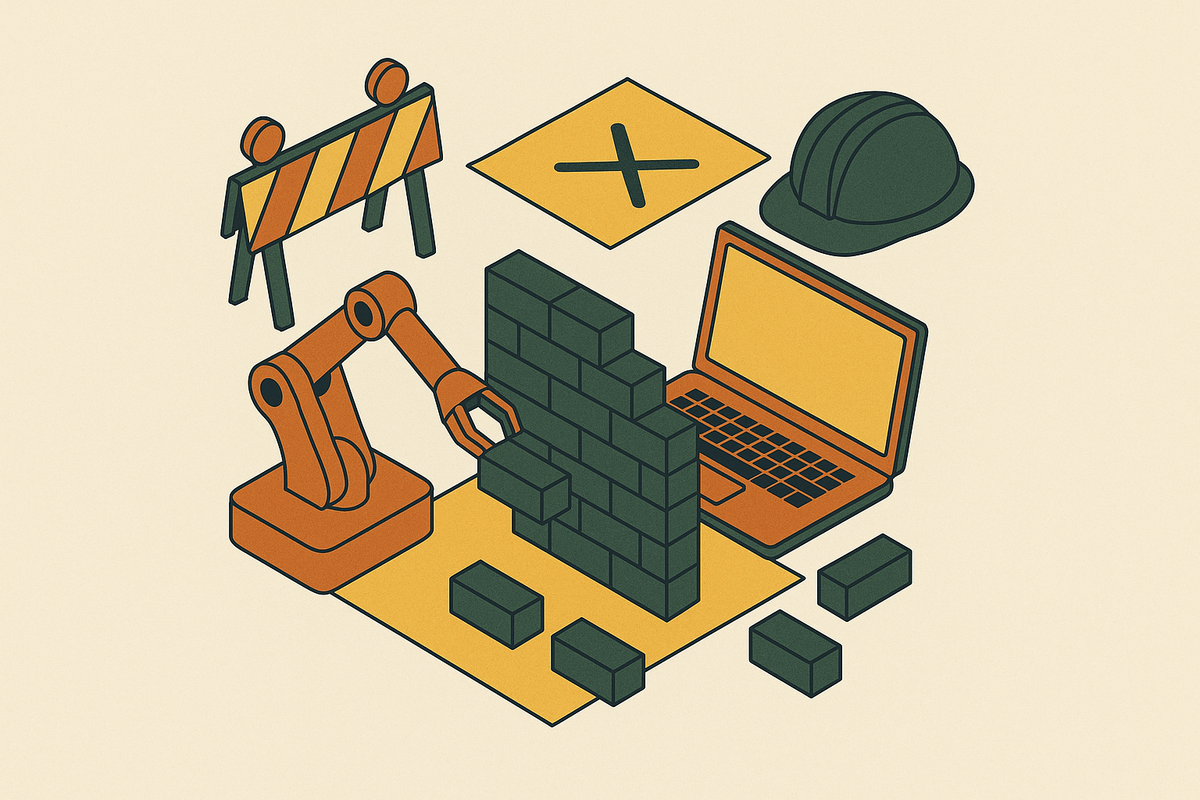
Rebuilding construction workflows with AI agents starts with auditing how work actually happens, then redesigning the sequence, decision rights, and data checks before introducing automation. Automating a broken workflow accelerates its failures because the defects sit in the process logic. Begin with one painful end-to-end process that can be rebuilt independently.
Why automating a construction workflow before fixing it makes the problem worse
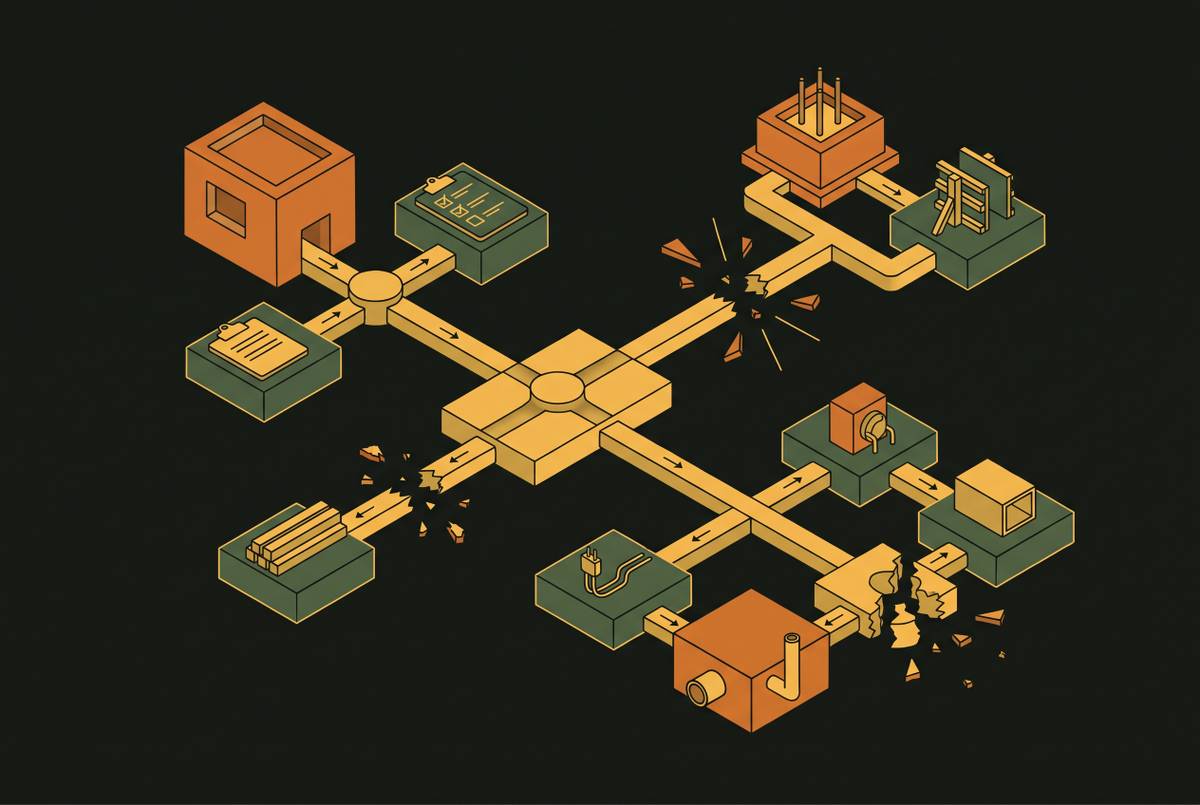
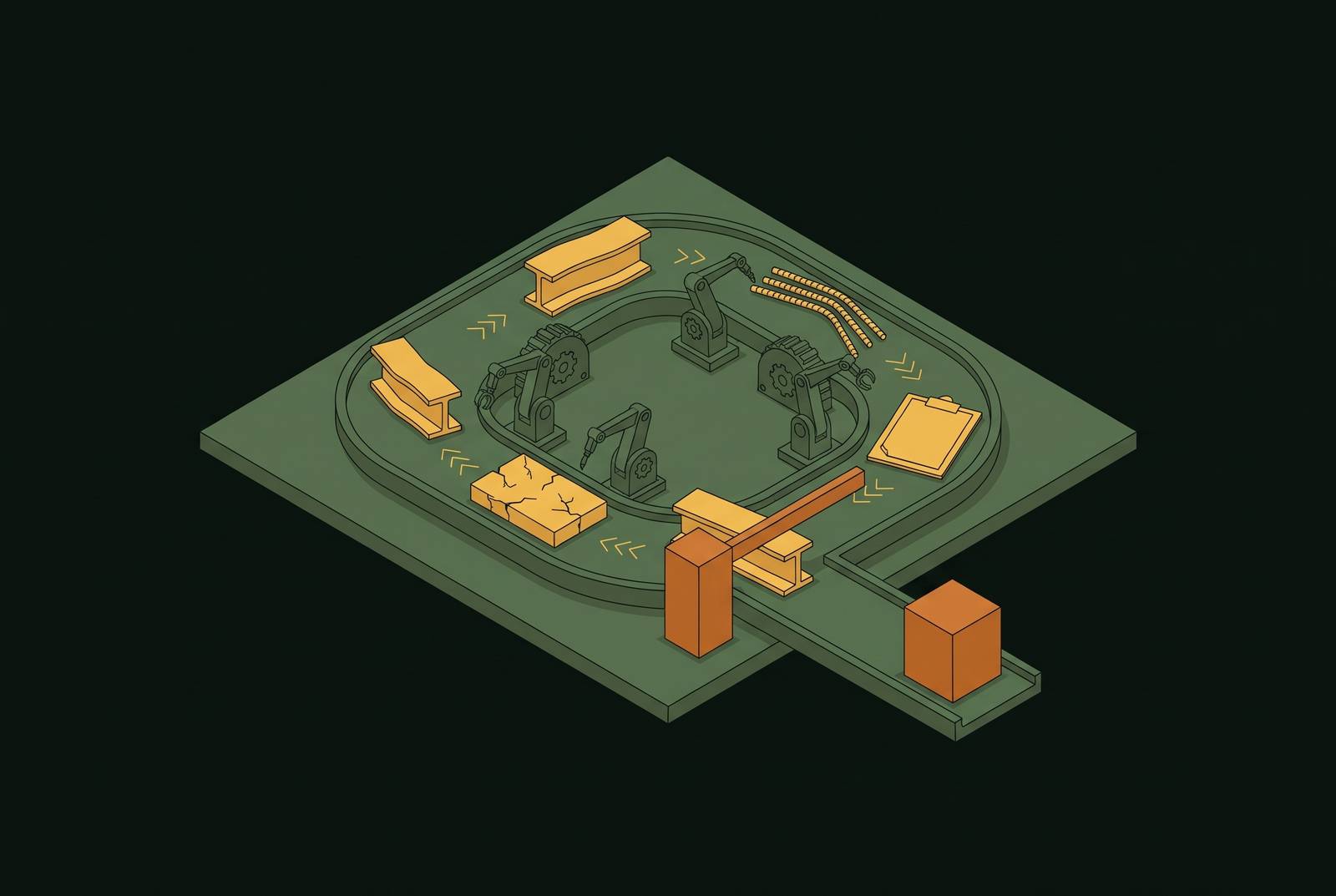
The automation loop repeats faulty process logic with tools that can do more and more. A team digitizes an existing sequence without examining whether its dependencies, inputs, or decisions are sound. The system then reproduces those defects faster and across more work. If the sequence is wrong, faithful execution makes the wrong sequence more efficient.
Automation can follow a dependency exactly as written without checking whether it matches how construction must proceed. It can also accept an input that looks complete while the information behind it is unreliable. The error precedes the automated action. Replacing the executor does not correct the instruction it receives.
Autodesk’s State of Design & Make: Construction Spotlight report found that just under a third of construction leaders say they have met or are close to meeting their AI goals. That finding does not establish the cause of every disappointing deployment.
What schedule data rot actually looks like inside a construction project
The baseline schedule is a common input for construction AI, yet in a large share of projects it is structurally unreliable. Broken logic ties, missing constraints, and durations with no observed evidence to back them up weaken the plan before optimization begins. Predecessor relationships can prescribe impossible sequences that have not been reviewed since the original submission. These are defects in the schedule’s operating logic. A document can be formally complete without describing executable work.
When an AI scheduling engine ingests that baseline, it searches for the optimal path through a fiction. Its output can look authoritative because the calculation is coherent within the supplied model. But internal coherence is not site feasibility. An impossible predecessor relationship does not become executable because an optimizer has incorporated it into a revised plan.
The resulting disconnect persists when the schedule was never the document people actually used to manage construction. Projects run late, but the baseline is not reconciled with field reality. Subsequent optimization therefore begins from the same unreliable account of the work.
Most AI scheduling systems have been trained on textual and structured data, including documents, records, and schedules. They can optimize a plan without detecting whether current conditions permit its execution. That limitation is not universal across construction AI. A growing class of computer-vision tools connects planned work with physical progress, but a scheduling model alone does not make that link.
How the same loop plays out at industrial scale in data center construction
Data center construction exposes the same sequencing defect through energization readiness. When energization is treated as a closeout task rather than a Day 1 procurement decision, the workflow postpones attention to constraints that should shape the build from the outset. Batteries, transformers, switchgear, and circuit breakers make up a small share of total construction costs. Yet they are binding dependencies for the asset. Without them, the capital spent on shells, cooling, racks, and GPUs cannot be energized.
The procurement procedure can exist on paper and still fail this test. Purchase orders issued on the old schedule cadence follow a recognized sequence, but that sequence does not reflect the lead times that should have been flagged years earlier. The defect lies in the placement of the procurement step in the process, with energization treated as a final obligation.
Faster execution of the old sequence accelerates spending on the wrong things in the wrong order, while the equipment needed for operational readiness remains the constraint. Construction completion is therefore not equivalent to cash generation. The gap between completion and readiness becomes a financing risk that the original workflow was not designed to surface.
In both cases, the formal sequence fails to represent a physical dependency, and the executing tool faithfully follows it. A better optimizer cannot substitute for a missing constraint. Identify where a particular workflow departs from the work it is supposed to govern.
What a real process audit finds that document review misses
A real process audit follows execution rather than stopping at the procedure that describes it. The evidence is on site, in lot records, in inspection and test plans, and in conversations with site supervisors and subcontractors. Some of those people may never have seen the quality manual. Whether the process works still depends on what those people do. An audit confined to the manual cannot establish how decisions are made or whether the documented sequence is followed.
Document review and field observation must therefore triangulate. Document-only conformity is a recognized cause of certification audit non-conformities because a process can pass on paper while remaining systematically broken in execution. The structural gap concerns the relationship between the organization’s declared controls and the actions through which work gets done.
For an operations team, the practical task is to observe the sequence as executed, map where decisions are actually made, and distinguish generated data from assumed or approximated data. That distinction identifies where the workflow rests on evidence and where it rests on convention. The audit must also examine who controls decisions. Otherwise, an agent trained on the documentation inherits the drift between the formal process and the site.
Conversational Process Model Redesign research proposes using LLMs to iteratively revise BPMN process models through user requests mapped to established change patterns. It does not establish an audit as a prerequisite for redesign or automation. Model editing and process discovery are different activities. The CIVIC-AI 2026 workflow framework makes a related distinction by arguing that usage logs, investment figures, and aggregate productivity do not capture changes in work itself, including shifts in task allocation and decision rights.
Where AI agents fail when the underlying process hasn't been fixed
The consequential failures here occur at the operating layer, where agents act on process logic. Silent propagation is a particularly serious construction example. An agent incorrectly records a submittal status, material delivery confirmation, or energization milestone, and the downstream schedule update inherits the error. The milestone is missed before anyone catches it. Without deliberate monitoring, the workflow can appear to be functioning while it distributes a false premise.
Undefined escalation creates a different form of information loss. An agent hands work to a human who no longer has the context needed to resolve it. The human then returns the task without confirming what changed. Responsibility moves, but the information remains degraded. This is a handoff defect that model capability alone cannot repair, because the process has not defined what must accompany the transfer.
Missing constraints create another failure path. Just as a scheduling engine cannot tell whether work is feasible on site from a faulty baseline alone, an agent cannot follow an operational requirement as an explicit rule when it has been left out. A capable model is not a substitute for sound task scoping. Recognizing, containing, and resolving an error within the workflow requires orchestration design and failure recovery logic.
The CIVIC-AI framework also identifies a weakness in nominal human oversight. Audit trails, sign-off protocols, and disclosure requirements can assume that reviewers retain the capacity to use them, even when redesign has eroded that capacity. The objection that stronger agents should catch errors humans miss therefore overlooks the governing issue, which is whether the process preserves the context, authority, and recovery paths needed to act on an error.
How to rebuild department workflows with AI agents from the ground up
The corrective approach begins with choosing a domain rather than a task, platform, or entire department. A domain is an end-to-end process small enough to rebuild independently but large enough to produce meaningful operational improvement. McKinsey’s July 2026 AEC analysis argues for transforming domains. Changing a single task may speed it up while leaving untouched the dependencies that make its output useful.
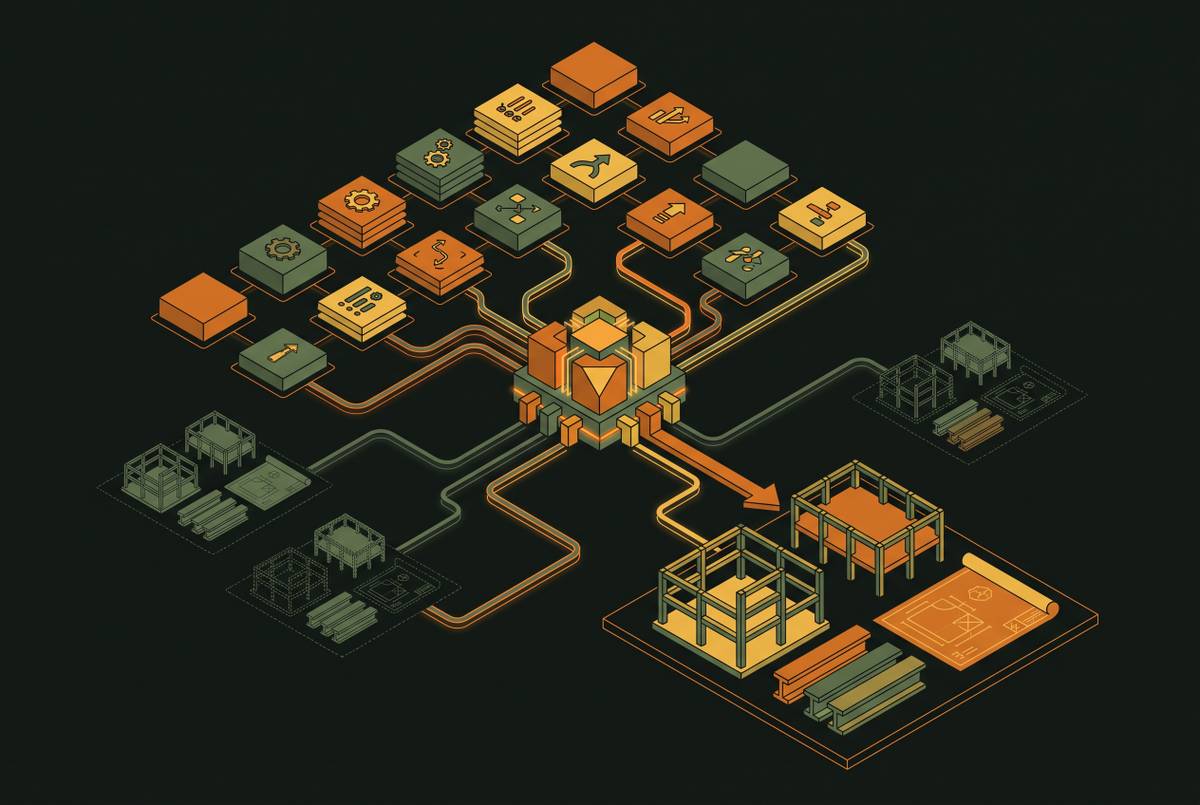
The Suffolk and MIT model shows why those dependencies belong inside the redesign. Its six AI-enabled levers compound when design data feeds permitting, scheduling, offsite manufacturing, skilled labor and subcontracting, and supply chain and procurement together. Isolated deployment captures only a fraction of that value. The relevant unit is therefore not simply the activity an agent can perform, but the connected work through which its output becomes useful.
The team maps the actual flow, identifies decisions that rely on assumed rather than verified data, and closes those gaps before sequencing automation. Human responsibility belongs in that design from the start. The CIVIC-AI framework identifies durable net value, meaningful human control, clear accountability and recovery, and long-term human development as conditions for genuine augmentation.
The organizational obstacle is that process steps often have separate owners with incentives to protect them. Redesign can require someone with authority across silos to resolve that resistance. Starting with one painful process reduces the political surface area and creates a live result from which the organization can judge the approach, rather than requiring agreement on an entire transformation roadmap before any work changes.
How to pick the first process to rebuild and what to expect when you do
The strongest starting candidate has a visible gap between the declared plan and field reality, a cost that people already feel, and a boundary that does not require fixing the whole organization. Frequent manual workarounds are one signal. Outputs regularly overridden by downstream teams are another, as is data recreated or re-entered at handoffs. A failure that people know about but treat as normal is another sign.
The diagnostic step is to show exactly how that process runs today and where it hurts. This is the basis for deciding both what to rebuild and what automation belongs in the rebuilt flow. Clean, structured data and feedback loops between design, construction, and operation are prerequisites for reliable AI decisions, and the audit establishes whether those foundations exist in the chosen process.
The diagnostic must also identify the human roles needed to oversee AI outputs. Removing routine work is not the same as preserving the ability to verify its results. Skill atrophy is a real failure mode. The CIVIC-AI framework’s human-capability condition means that a rebuilt workflow must retain the skills through which people can evaluate outputs, exercise control, and recover when execution goes wrong.
A process-first approach should aim for a live rebuilt process in weeks. Long timelines are a signal that the unit of analysis is too broad or that the work began with a platform. This is not an argument for an inconsequential pilot. A pilot that leaves the underlying process unchanged proves little, while a rebuilt process running in production demonstrates the method and gives the organization a concrete basis for choosing the next domain.
Change across the whole enterprise can start with one process and grow from there. The distinction is between a small technology trial and a complete change to a bounded piece of work. The latter establishes whether the new sequence, data checks, decision rights, and recovery logic function together. Expansion then rests on an operating result.