What AI Agents Reveal About How a Construction Department Should Actually Be Structured
AI agents expose which construction workflows lack clear ownership and defined handoffs.
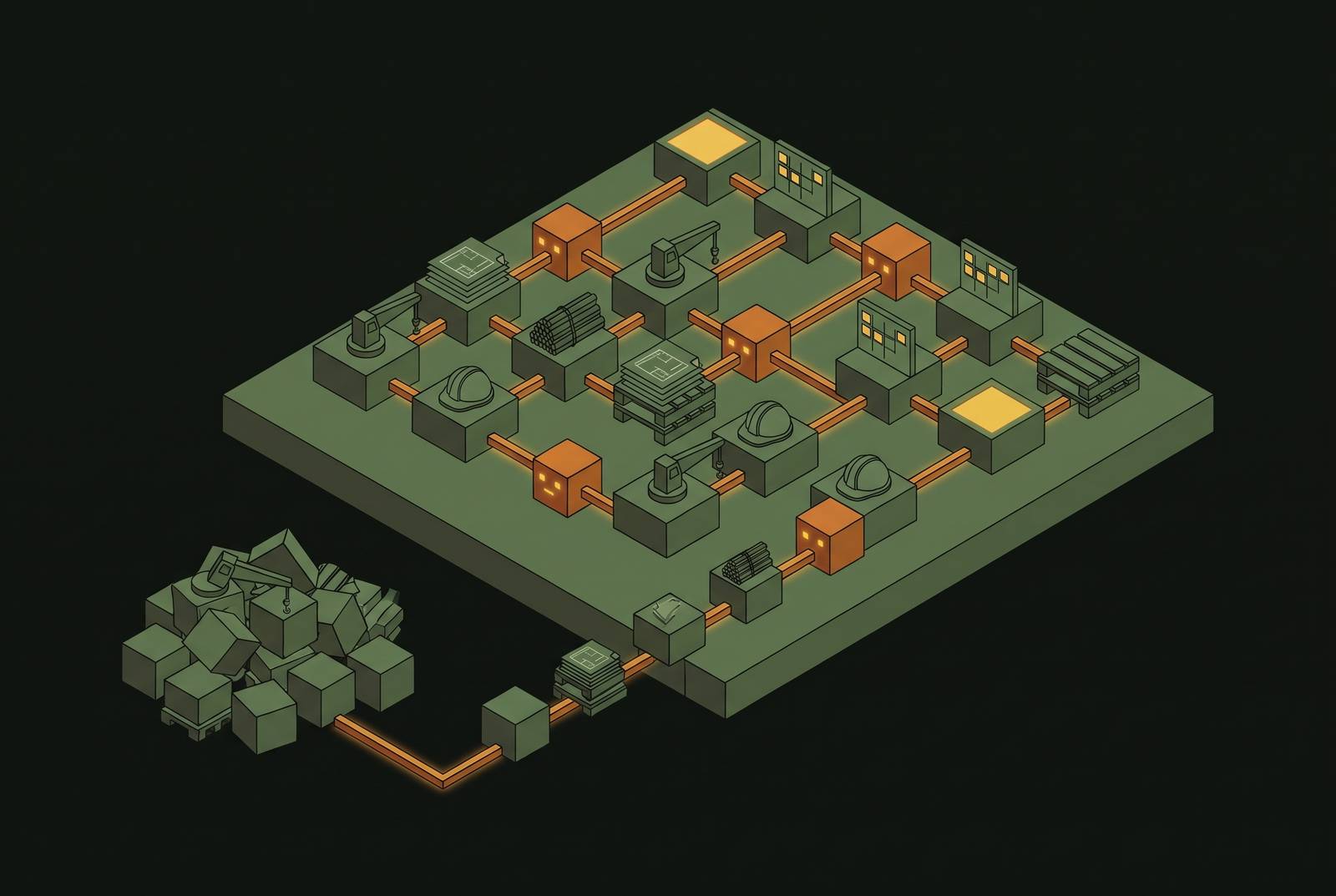
Rebuilding a construction department’s workflows with AI agents starts with assigning ownership, defining evidence of completion, and rebuilding handoffs before automating them. Agent deployment is a structural audit because it exposes work that depends on personal intervention in the absence of a defined process. The department should be organized around information flow and decisions, with people responsible for judgment and exceptions.
Why construction departments are organized around coordination heroics rather than information flow
Construction software promises better coordination, but storing information does not move the work it describes forward. Platforms log RFIs, record submittals, and archive schedules, while people still chase responses, find missing attachments, and assemble reports. The structural gap arises from designing the department on the assumption that an experienced person must personally move each workflow from one step to the next.
That assumption shapes roles as well as routines. Project professionals become responsible for both making decisions and moving the information needed to make them. Document routing, status chasing, and report assembly therefore compete with technical judgment for the same people’s attention. These tasks take their time but may not need their expertise. A department can have skilled staff and plenty of software and still rely on people to keep pushing ordinary work along.
The resulting hierarchy makes coordination effort look like an unavoidable part of project delivery. A reliable coordinator becomes the answer to an unreliable handoff, and personal knowledge substitutes for explicit ownership. Better execution within that arrangement can conceal its weakness. Autonomous systems challenge the arrangement because they create an alternative for routine workflow execution, but they also require the department to distinguish that execution from the judgment surrounding it. Deployment therefore tests the design of the department before it tests the usefulness of the agent.
What deploying an AI agent actually requires a department to answer
Before an agent can take over a workflow step, the department must explain what that step actually is. It must name the owner, say what counts as done, and show where responsibility passes to someone else. Those answers cannot remain implicit in a project manager’s habits. If RFI procedures vary by manager or submittal routing depends on who happens to be available, the department has not supplied a stable process for an agent to execute.
This requirement exposes ambiguity that earlier software could tolerate. A system of record can hold a document even when nobody has formally assigned responsibility for moving it forward. A person can notice the omission, find the right recipient, and compensate without changing the documented process. An agent cannot reliably reproduce that unwritten arrangement. The obstacle is not merely access to the document, but the absence of an agreed rule for what should happen next.
A stalled deployment is therefore useful evidence about organizational design. It may show that the process is too inconsistent to automate or that ownership has never been formally assigned. Neither finding is resolved by treating deployment as an IT readiness exercise. The department must settle the operational question that the technology has exposed, including whether different project practices represent necessary exceptions or undefined routines. That difference decides what can follow a standard process and what needs a person to decide.
The deployment decision consequently reaches beyond task automation. It asks whether the department can describe its own work precisely enough to delegate it without relying on someone to repair the instructions.
The specific workflows where structural breakdowns become visible first
RFIs and submittals expose the problem at familiar handoffs. RFI procedures that change with the project manager leave an agent without a consistent route, while submittal coordination often breaks between the person assembling the package and the person routing it. Submittal coordination consumes three to five hours per week per PM. Diagnosing the handoff requires identifying who owns the transition.
RTS Labs’ implementation analysis describes agents that adjust project timelines in response to labor shortages, equipment downtime, and weather. That requires connections to live sensor, telematics, and procurement data, which most departments have never established. Without those connections, people still have to gather changes from elsewhere to keep the schedule up to date. The schedule may be kept in one place while the duty to keep it up to date is spread across people.
That split is especially clear in procurement coordination when a design changes. Quantities, delivery schedules, and execution plans should change together, yet a coordinator often walks the change through each system because procurement decisions are made apart from schedule and field data. Automating a single step exposes the missing links without necessarily resolving them.
Energization and commissioning readiness extend the problem across a dependency chain. Procurement must connect to installation, installation to inspection, and inspection to commissioning. Each transition tests whether completion means the same thing to the team finishing one stage and the team beginning the next. Because this chain mirrors multi-agent orchestration, it is especially diagnostic of unclear handoffs. Each activity an agent performs must produce a dependable basis for the next.
How the declared process and the actual process diverge — and why agents make that gap impossible to ignore
These workflow failures reveal more than incomplete procedures. They expose a difference between the process the department believes it runs and the process that actually gets work completed. Experienced coordinators bridge that difference through institutional knowledge and informal escalation. They know when to call the structural engineer directly or flag a submittal before it reaches the PM. The process map rarely shows that work.
Those interventions are a practical response to a structure that leaves people to reconcile formal instructions with operating conditions. Over time, a department can mistake the success of those interventions for the success of its declared process. The distinction remains hidden while experienced people keep compensating. It becomes visible when one of them leaves, becomes overloaded, or is replaced in a workflow by an agent.
An agent executing the documented process removes that compensation. The resulting failure can appear to show that automation cannot handle construction work, when it actually shows that the instructions never described the work completely. This is a consequential distinction in commercial construction, where profit margins are thin. The cost of informal coordination is difficult to isolate while it is embedded in ordinary project effort, but its absence exposes how much execution depended on it.
Field evidence provides another way to see the divergence. RTS Labs describes agents that review site evidence and cross-check project files to compare the work on record with what site imagery and sensor data show was done. A recorded statement of completion is not the same as evidence of completion. When those disagree, the finding points to how the department does its work as well as how well a document was written. Its records may describe intended execution while its people are managing a different reality.
How to redesign a department’s entire workflow around AI agents instead of patching old processes
A department organized around information flow separates routine execution from decisions that require experience. Agents advance defined workflows, while people validate outputs, resolve exceptions, and make cross-functional decisions. The change reaches into job design. Roles centered on submittal coordination, RFI tracking, or report compilation become roles responsible for the cases that routine execution cannot resolve.
RTS Labs’ framework distinguishes this arrangement from a system of record. Agents gather information across systems, interpret context, make decisions, and act, while humans retain responsibility for critical decisions. That distinction requires more than connecting software. The department must assign responsibility at the points where routine action ends and human judgment begins, so an exception has an owner rather than becoming another item for someone to chase.
Multi-agent architectures make those boundaries clear by giving each agent its own part of the work. A planning agent proposes a sequence, a commercial agent validates contractual exposure, and a safety agent assesses method statements. A supervisory agent reconciles conflicts before work begins. Human oversight remains at the decision boundaries.
This creates operational roles. Human-in-the-loop validators check what agents produce, exception escalation owners deal with cases that fall outside routine handling, and digital workforce managers run teams of agents and people. Each role needs domain expertise to judge whether the workflow produces a result that is good enough for the work.
The test is how experienced professionals spend their time. A substantive redesign gives them more time for field verification, client relationships, technical judgment, and risk assessment, and less for information logistics. If they still have to chase every transition, the department has added agents without changing its underlying structure.
Why restructuring fails when agents are added to a process that was not rebuilt first
Agents added to an unreconstructed process inherit its unresolved dependencies. They can amplify existing dysfunction or expose problems that the organization is not prepared to address. Faster execution can move an incomplete or mistaken result into the next workflow before a person has compensated for unclear ownership, making the original structural weakness more visible.
The risk grows when agents depend on one another. A procurement-agent failure can propagate to a scheduling agent and then into a field execution plan, producing disruptions that take weeks to unwind. Isolated failure boundaries and validation of inter-agent communication are therefore structural requirements as well as technical ones. They keep a problem within one workflow and prevent it from cascading across the department.
Undefined authority creates a related failure mode. When agents act outside policy boundaries, or reviewers cannot reconstruct what happened and why, the immediate response may be to shut them down. That can stop the agent’s activity without resolving the process that made its actions unacceptable or difficult to understand. The department returns to human coordination with the original ambiguity intact. Technology gets the blame while the way the work is set up goes unchanged.
The lesson from logistics and manufacturing is that workflow changes drive improvement. Organizations deploying agents into processes they had not redesigned captured only a fraction of the available gain. Extensive agent adoption can coexist with dependence on coordination heroics if ownership and handoffs remain untouched. The appropriate response to that kind of failure is a process audit.
Starting the structural audit before the first agent is deployed
The audit starts with one painful process: the workflow in which experienced people spend the most time doing work that should not require their experience. Beginning there gives the audit a concrete object rather than turning it into a platform strategy or a broad transformation roadmap. The purpose is to understand how that work gets completed today, including the interventions absent from its formal description.
For a department beginning that audit, the first step is to show the current process and where it hurts. The next is to identify handoffs that depend on informal coordination, including places where ownership is assumed. Ownership and evidence criteria can then be formalized before an agent is designed into the workflow. The order is essential to the diagnosis. Starting with agent configuration risks encoding the declared process before anyone has established whether it matches actual execution.
Who owns each step, what proves that it is complete, and where does the handoff actually occur? Answering them before deployment makes the findings available for redesign before the gaps emerge as failures. It also separates routine execution from the exceptions that need an experienced person. An agent can then work within a rebuilt process without relying on people to make fixes behind the scenes.
Some improvements can precede the technology itself. Assigning ownership closes coordination gaps that existed because nobody had been made responsible for closing them. The goal is one process rebuilt end-to-end, with an agent operating inside it, live within weeks. That first implementation can expose the next structural gap to address. Progress then comes from rebuilding a connected piece of departmental work.