Redesigning Department Workflows Around AI Agent Capabilities Not Legacy Job Functions
Organizations must redesign workflows around agent capabilities, not legacy job functions.
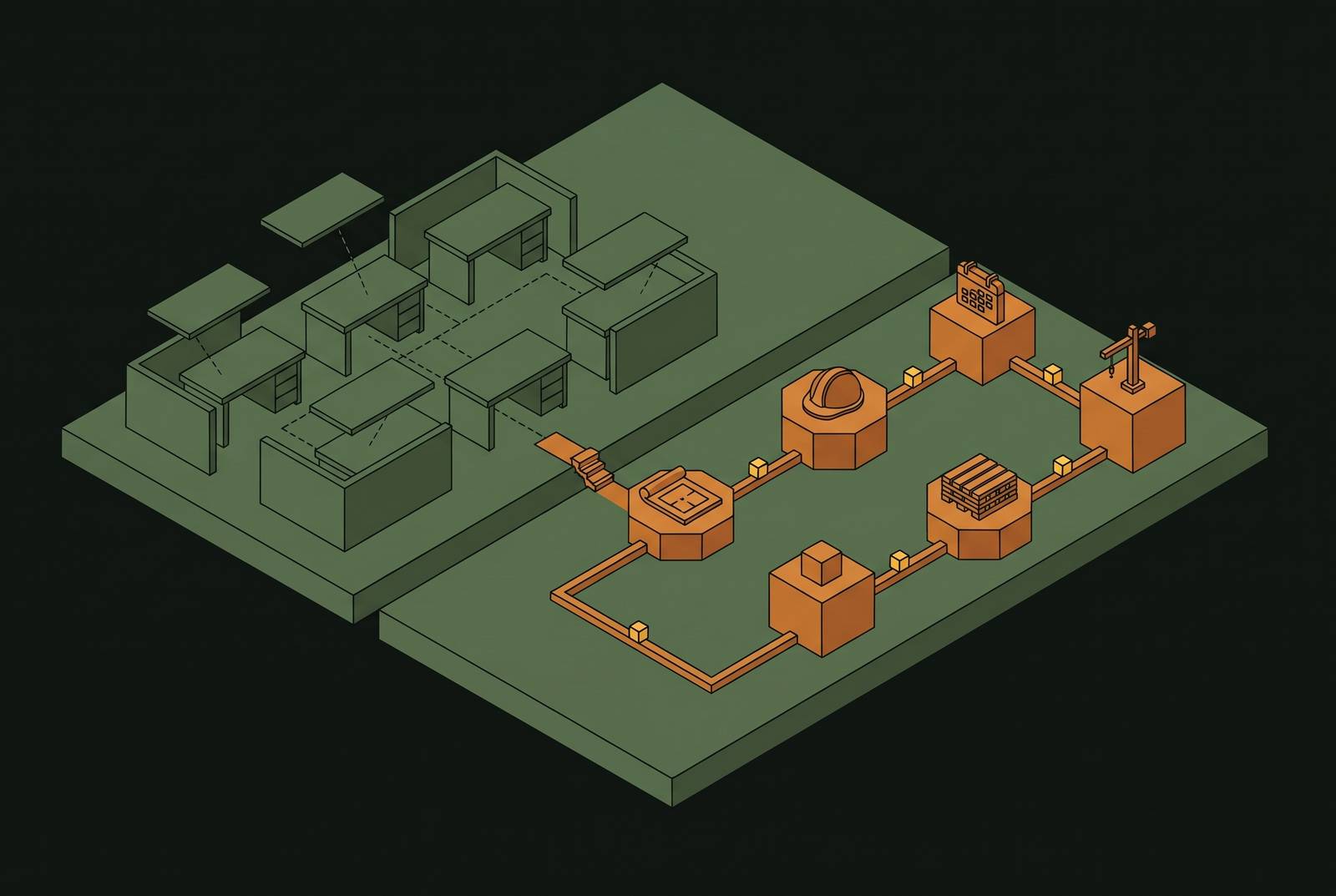
Rebuilding department workflows with AI agents from scratch means auditing how work actually runs, then redesigning its decision logic around what agents can do autonomously. Agents should coordinate work, act on validated data, and route genuine exceptions, with room to work across legacy job boundaries. The workflow design makes autonomy useful. Without that redesign, automation accelerates the dysfunction already present.
Why workflows designed around human roles fail when agents are inserted into them
Sequential handoffs, role-based gates, and approval chains divide work around human bandwidth, attention, and accountability. An agent can keep track of context through a long sequence and coordinate several steps at once, but a legacy workflow still makes it wait at each checkpoint built for people. The constraint sits in the process itself. Assigning an agent to a job function preserves that constraint even when the agent can perform the function’s individual tasks faster.
Deloitte’s agentic AI analysis identifies this mismatch in enterprises trying to automate tasks designed by and for human workers without reconsidering how work should proceed. It warns that “poorly designed agentic applications can actually add work to a process”. Human workarounds explain part of that risk. Experienced workers make up for unreliable data and deal with failures to coordinate work that the written process never mentions. When agents inherit the documented sequence, those hidden dependencies become blocked handoffs, amplified errors, or additional demands for human intervention.
What agents can actually do autonomously, and why that is the right starting point for workflow design
An agent can work toward a goal over several steps without being told what to do at every turn. It maintains a representation of its objective and progress, adjusts its plan when new data or errors appear, and interacts with external systems to read, write, and update information. These capabilities change where work can be joined. A sequence that previously needed separate people to gather information, interpret it, and pass it onward may no longer need those divisions.
In practical terms, agents can retrieve and validate data, detect anomalies, route exceptions, trigger downstream actions, and coordinate across systems. Human judgment still defines a boundary for autonomy. The design must separate decisions that need that judgment from those that have simply passed through a person’s inbox in the past. An assistant responds to prompts within an exchange, while an agent pursues an outcome across a sequence. A workflow that requires a fresh prompt or handoff at every step prevents the latter from operating as intended.
The Harvard Data Science Review’s agent-centric enterprise analysis gives agents the main role in doing the work, instead of adding them to processes built around people. That distinction sets the test for each checkpoint. A step needed to validate a condition serves an operational purpose, but a step needed only because a human could not retain context or validate continuously may be removable. The capability inventory therefore precedes any decision about which existing roles an agent might replace.
Why the process audit must come before any workflow redesign decision
The capability inventory needs a map of the actual process to operate on. That map must include decision points, informal workarounds, and handoffs kept because of how the organization is structured. Written procedures are not sufficient evidence of execution. An agent deployed against the declared process will still encounter the undocumented process when it begins working across systems and teams.
A useful audit records ownership, decision rights, accountability, and escalation paths as well as task order. These determine where an agent has authority to act and where another decision-maker must intervene. A procurement check may compensate for errors the ERP should have caught, while an approval gate may exist because an earlier system could not validate information in real time. Those steps are candidates for elimination only when their underlying function is addressed.
The operational discipline is to show exactly how the process runs and where it hurts before deciding what to rebuild or deploy. From that evidence, the redesign can ask what the process would look like if it were being built from scratch for an agent to run. That is different from asking where AI fits. The first question permits a new sequence of decisions and data flows, while the second tends to preserve the old sequence and assign automation to its parts.
How the redesign logic plays out in construction scheduling and procurement
Static schedules built in tools such as P6 reflect plans maintained through periodic human review. An agent reading that schedule inherits its limitations. If procurement and commissioning data contradict the declared dates, faster reasoning over the schedule alone produces confident outputs against a plan that no longer describes execution.
The Suffolk and MIT analysis shows why integration is needed by linking gains to changes across several construction workflows. Design data must feed planning, procurement, manufacturing, and field execution simultaneously, rather than pass through an unchanged sequence with an agent attached to one stage. The dependency is broader than scheduling software. An agent cannot coordinate work reliably if the information needed to understand readiness remains separated from the information used to plan it.
For a construction team, the redesign must therefore connect agents to data sources that reflect actual field state and rebuild the associated decision logic. That changes what prompts a scheduling or procurement action. Instead of treating the latest declared schedule as sufficient, the workflow must account for the procurement and commissioning conditions that support or contradict it.
How logistics and retail reveal the sequential handoff problem at scale
Logistics and retail often organize work as a relay from forecasting to allocation, procurement, and execution. Each handoff introduces delay and a potential gap in the information available to the next stage. Better forecasting improves one part of a process whose later decisions still depend on sequential transfers.
A non-delivery shows how a different architecture changes the response. In a well-designed multi-agent workflow, one agent’s discovery allows other agents to evaluate partial shipments, resequencing, and alternative routing simultaneously. The alternatives can be considered in parallel because the process permits coordinated action across steps. In a sequential workflow, the same discovery must move through the established chain, so an agent can improve only one leg at a time.
Retail replenishment has the same weakness when allocation, procurement, and execution each have to wait for separate forecast handoffs. Frontline participation adds another dependency to the redesign. Warehouse, dispatch, and brokerage teams need to understand how their roles change, because teams that route around the new workflow leave agents with incomplete inputs.
What manufacturing's three-layer requirement reveals about the dependencies redesign must address
Agents need current operational data, a process that permits action on that data, and people prepared to work within the new division of responsibility. None of these layers works independently of the others. Redesigning the sequence alone cannot produce reliable autonomy if the infrastructure still supplies information for periodic human review or the operating model still requires manual coordination.
McKinsey’s November 2025 case study of Jubilant Ingrevia grounds this requirement in a manufacturing transformation. The case brings together digital infrastructure modernization, operational workflow redesign, and a structured skills transformation program. These changes took place at the same time. The case links operational improvement to the interdependence of these changes.
Digital twins and IIoT infrastructure provide the real-time operational data on which agent action depends. Deloitte’s analysis identifies a related obstacle in enterprise architectures built around ETL processes and data warehouses, where information is not positioned for agents that need business context and real-time decisions. Data availability is therefore part of workflow feasibility. A process may authorize an agent to act continuously while its underlying architecture cannot support the decisions involved.
This mismatch helps explain why a controlled pilot can get stuck when it moves into production. The pilot shows how the workflow logic works, but keeping the same infrastructure and ways of working stops the agent from working as designed across real operations. Adoption figures require equally careful interpretation. Deloitte reports that only 24% of B2B suppliers have worked on agentic AI, a figure for what those suppliers have done so far that does not forecast manufacturing adoption for end-2026.
How governance architecture either enables or defeats agent-centered workflows
Governance determines what an agent may do at every decision point, making it part of workflow architecture. Deloitte’s agentic strategy research identifies legacy integration, unsuitable data architecture, and governance that does not account for independent decisions as obstacles to production readiness. These obstacles interact within the process. Permission to act is of little operational use if the integration blocks execution, just as accessible data is insufficient when decision authority remains undefined.
Uniform controls fail in two opposing ways. Over-restricting simple agents slows delivery and encourages workarounds outside the governed system. Too few limits on more autonomous agents raise the risks to operations, security, and compliance. Controls must fit the agent’s autonomy and the risk of its decisions instead of copying the access and approvals for a single human role.
Multi-agent coordination also makes failure boundaries a workflow requirement. An error in a procurement agent can propagate to production scheduling and then logistics, creating disruptions that take weeks to unwind. The architecture must stop that cascade from spreading across steps that depend on one another. Giving each agent permission to do its own task does not provide that protection, because an action allowed at one step can still spread a failure through the wider process.
Research accepted for presentation at the AGENTICS 2026 conference identifies recurring governance, transparency, coordination, and safety gaps, as well as plateaued improvement despite model upgrades. These include agents acting outside policy, reviewers being unable to reconstruct actions, agents drifting out of step, and untrusted content contaminating trusted reasoning. If a human cannot establish what an agent did and why, the workflow lacks the accountability needed for mission-critical use. Auditable action must be designed into execution.
How to rebuild a department workflow around agents instead of patching old processes
For practitioners applying these findings, the first design principle is to make decision logic explicit. Experienced workers often use tacit judgment to fill gaps in written procedures, but there is no reason to assume that an agent shares that judgment. Every decision branch needs a defined disposition. Undefined branches either become failures or push work back to people, undermining the intended division of responsibility.
Trigger handoffs through data readiness. “Send to procurement when engineering sign-off is complete” describes a role-based handoff. By contrast, “trigger procurement workflow when drawing revision is finalized and BOM is validated” specifies conditions an agent can act on. The distinction changes the basis for progression. Work moves because the required state exists.
Escalation needs the same precision before deployment. The agent needs a definition of an exception, an identified human handler, and a clear account of the data to surface. The Harvard analysis describes humans as supervisors, coaches, and handlers of exceptions in the agent-driven operating model. That division is only real when people stop supplying the routine coordination omitted from the workflow design.
Begin with the department’s most painful, high-frequency process. A narrow, well-defined process makes it possible to complete the audit, rebuild the decision logic, and produce field evidence for extending the approach. The barrier is doing that work with sufficient precision. Start with one specific process whose pain is clear, then redesign it properly before widening the scope.