Change Order Process Redesign for General Contractors
Fixing change orders requires rebuilding the pre-construction handoff, not faster approvals.
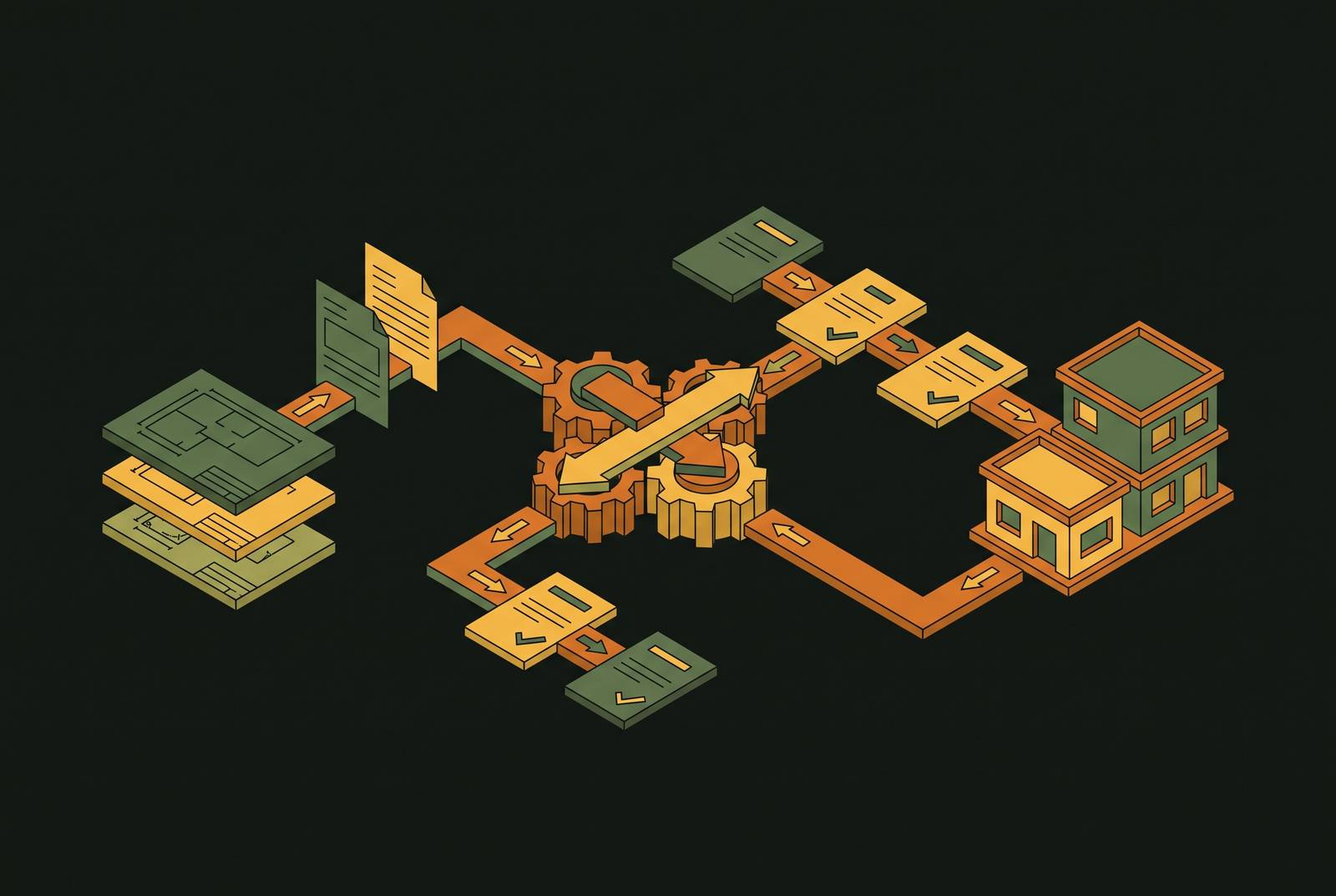
Change order process redesign for general contractors begins with a process audit. Trace where scope, cost, and schedule data lose their meaning as they pass from pre-construction to project management, then rebuild that handoff before automating approvals. Change orders are an information-latency problem, and faster routing cannot repair the missing assumptions that created them.
Why change orders keep surprising general contractors despite better software
Better software has not closed the gap between field activity and the records used to manage it. Change orders still arrive as emails, phone calls, and field sketches that do not reach the master schedule or budget until weeks after approval. The process generating the changes explains the persistent overruns.
A commercial project accumulates dozens of change orders across its lifecycle. Each untracked change pushes the eventual cost further beyond the stated budget, and those increases compound. A system can therefore show an orderly approval queue while the project operates against an outdated baseline. The structural weakness is that information enters the control process after its consequences have begun.
Where change orders actually originate — the pre-construction to project management translation failure
The root cause of most change orders is a translation failure between pre-construction intent and what project management receives at contract execution. Estimating teams review drawings, specifications, contracts, addenda, and RFIs under compressed bid timelines. Their decisions establish what is included, what is excluded, and which risks the price covers. If those decisions are incomplete or lose their meaning during transfer, project management inherits a contract baseline without the reasoning needed to interpret it. The gap can remain invisible until it becomes a scope dispute, buyout difference, or field RFI.
Provision's 2026 guide identifies the document-level mechanism behind that failure. A required item may appear in one document and be changed, contradicted, or omitted in another. Missing the conflict does not remove the obligation. Instead, the missed scope or unpriced risk migrates downstream, where it becomes a change order, subcontractor dispute, or unrecoverable cost. What appears to be a new field problem may therefore be an unresolved bid assumption.
Subcontractors have become more systematic about identifying and billing scope gaps. A pre-construction lead at a top ENR Canadian GC put the consequence plainly. "If you miss anything, they'll bill it. Informal agreements no longer cover them." By the time such a gap reaches approval, the process is handling a failure already incurred. Terminal Use's process-audit methodology starts at this earlier boundary, tracing whether scope, cost, and schedule assumptions survive transfer into project management before deciding what to rebuild.
How the handoff between pre-construction and project management breaks down in practice
The handoff is a series of data migrations between estimating, project management, scheduling, and financial systems. Budget assumptions, scope exclusions, alternates, and allowances do not automatically retain the structure or meaning they had in the bid documents. A downstream system may receive the budget without receiving the qualifications that explain it. The transfer is complete administratively but incomplete operationally.
That distinction matters because project managers must act on the information they inherit. If an allowance appears without its underlying assumption, they cannot interrogate the baseline in the same way the estimator could. Field superintendents then make decisions against scope and sequencing that were never fully communicated. The next person cannot reconstruct the decision the file was meant to support.
Separate commercial, estimating, spreadsheet, and financial records make that loss harder to see. Each system may do its own job while project managers fill the gaps by working out what the data mean and entering them again by hand. In the end-to-end approach used by Terminal Use, redesign addresses this loss of scope and cost fidelity. The test is whether teams can still use the information from bid day through field execution. Moving it faster is secondary to preserving what it means.
Why patching the approval workflow accelerates the problem rather than solving it
The approval bottleneck is downstream of the translation failure. A single change order usually needs signatures from the GC, owner, architect, and trade partners. Without centralized tracking, that cycle can stretch over weeks while crews stop work or proceed on assumptions. Pre-populating impact data and routing the request to the right stakeholders can remove manual handoffs. Those improvements address delay, but they do not prevent the missing scope that generated the request.
The distinction is between processing changes and controlling their causes. Faster approval of the same broken information can accelerate scope drift. A shorter cycle time is therefore an incomplete measure of improvement if the volume and consequences of avoidable changes remain untouched. Terminal Use's emphasis on rebuilding departmental processes rather than patching individual steps follows this distinction. Streamlining the gate is not a substitute for repairing the information that reaches it.
Many firms charge corrective work to the original cost code, so reports never identify it as rework. An AI system trained on those records learns a baseline that conceals the correction. Even efficient routing can then optimize against a misleading account of project performance. Automation cannot compensate for a measurement system that records the consequence under the wrong meaning.
What a rebuilt change order process actually controls — scope, cost, and schedule data before approval
A Canadian GC working on an acute-care hospital project used AI-assisted document review to find fire and smoke separation ratings that were wrong, positive-pressure room requirements that were missing, and problems with medical gas coordination. These were issues that, left undetected, would have become change orders deep into construction. The important feature is when the team found them. Document review exposed the gaps while they were still scope problems, before they required field corrections.
A rebuilt process applies that upstream control logic to changes that arise during delivery. It captures scope, cost, and schedule information when a potential change is identified, then routes it against the original contract baseline. Intake pulls data from email attachments, mobile site photos, and direct portal uploads, with no need to enter the data by hand. The target is zero lag between field identification and system entry. With every delay, the project risks decisions made by people who have yet to see the proposed change.
Once each proposed change is captured, it is checked against the original contract value, current committed costs, and the budget left for each trade and cost code. This makes scope creep visible before it cascades through the budget. The approval request arrives with impact analysis rather than as a blank form requiring decision-makers to reconstruct the consequences.
Schedule control must operate at the same pace as cost control. When an approved change affects duration or sequencing, the master plan should update at approval. Field superintendents can then work from a daily plan that reflects the decision just made. Intake, comparison, approval, and reconciliation then work as parts of the same process.
Where AI agents belong in a rebuilt change order workflow — and where they do not
AI agents belong at defined information handoffs, where their work can preserve or reconcile the project baseline. Before bid day, document intake and scope gap detection can flag missing, unclear, or conflicting requirements across drawings, specifications, contracts, and addenda. Provision's 2026 guide places the value of that review while teams can still issue RFIs, adjust exclusions, or update pricing. Design depends on what information an agent needs to carry through the process.
During construction, agents can use cost thresholds, contract terms, and schedule impact to choose how to route a change. They can also reconcile financial forecasts and master plans when approval occurs. For agents to do this work, cost codes, work packages, and stakeholder roles must mean the same things across systems. Without that standardization, an agent may translate costs inconsistently between accounting, scheduling, and project management. The original handoff failure then reappears inside the automation.
Approval judgments about field conditions, owner relationships, and contract ambiguities remain human responsibilities where they extend beyond the system's data. Human sign-off provides the governance that makes automated routing safe. AI-assisted workflows should start by running alongside the manual process. Teams can check flags against their own judgment on actual change orders before handing over responsibility for the workflow. An audit establishes what the agent should do, and parallel operation tests whether it does that work reliably.
High-stakes environments where change order failures have irreversible consequences
In data centers, hospitals, and energy infrastructure, a late change can disrupt the order in which equipment is due to arrive, set months earlier. Faster approval cannot put that sequence back in place once it has been disrupted. The risks to the project go beyond the amount shown on the change order. Cost, procurement, construction, and commissioning must be understood together because a local scope decision can invalidate a wider delivery plan.
Projects in Northern Virginia have been physically completed on schedule and then sat dark for months awaiting utility energization. That wait shows how a P6 schedule can record what teams plan to build without showing whether they can achieve it. The constraint may sit in procurement and commissioning data. A change order process that looks only at activity dates can miss a requirement for operating the facility. Physical completion and operational readiness are not interchangeable milestones.
Alphabet's acquisition of Intersect Power signals that major owners are internalizing the energization constraint rather than leaving it to the construction supply chain. For GCs, procurement and change order discipline therefore bear on their ability to deliver these projects. Acute-care hospitals present a different but equivalent consequence. The missing positive-pressure room requirements and medical gas coordination problems identified in pre-construction were scope corrections at that stage. If those same issues were found during commissioning, they would be regulatory failures.
How to identify which handoff to fix first before deploying AI
Start with a process audit of the most painful specific failure. Trace an actual change from field identification through system entry, approval, and schedule update. At each transfer, establish whether someone moves the information manually, re-enters it, or interprets it for the next system. Then compare what the downstream recipient received with what the upstream team sent. The point where meaning degrades takes priority.
This test also applies to logistics and other field operations before AI deployment. The audit must distinguish absent capability from existing tools that do not operate as a connected system. In construction, project managers often make that connection, and linking systems by hand breaks down when work piles up and deadlines press. Owner changes, differing site conditions, and design clarifications are useful first redesign categories because they drive overruns and have clear approval logic.
The trace should extend back into pre-construction whenever the change exposes an inherited scope gap. Before bid day, the team can still seek clarification, adjust exclusions, or revise pricing, which can prevent the change order. A process audit such as Terminal Use's begins by having the client show how work runs today and where it hurts, then uses that evidence to choose the first redesign. The first action is therefore concrete. Map the actual handoff, find where scope, cost, or schedule data lose fidelity, and repair that point before deploying AI to carry the information faster.